Light and Reflection

What is light???

Light is a type of energy which travels as a wave from a luminous source (eg the Sun, a flame, or a torch). Not everything is a light source. Paper reflects light from a light source towards your eyes, making you able to see it.

Light travels at a speed of 3×10⁸ m/s. Light travels faster than sound which is why you see a flash of lightning before you hear thunder! It takes 8 minutes for light from the Sun to reach Earth.

Light travels in straight lines. It can’t bend itself around objects if they are in its path. Shadows occur where light has been blocked by an object.

………………………………………………………………..

Light reflection

Lots of spectacular and beautiful effects are caused by the reflection of light. Reflections occur when light bounces off the surface of water or some other smooth surface into your eyes.

Reflection from smooth surfaces (eg mirrors or calm water) leads to regular reflection. Bumpy or rough surfaces do not reflect light evenly. The light isscattered in all directions, and usually we cannot see an image. This is known as diffuse reflection.

………………………………………………………………..

Mirror: Light reflection

Light can be made to change direction with mirrors – this is called reflection. When light is reflected off a mirror, the angle at which it hits the mirror (angle of incidence) is the same as the angle at which it is reflected off the mirror (angle of reflection). The rays of light which hit the mirror are called the incident rays; those reflected off the mirror are called the reflected rays. The angles are always measured from the ray to the “normal”. The normal is a line at right angles to the mirror.

The laws of reflection Terms:

  • Angle of incidence: The angle between the ray of light that hits the mirror and the normal.
  • Angle of reflection: The angle between the ray of light that is reflected off the mirror and the normal.
  • Incident ray: The ray shinning onto the mirror.
  • Reflected ray: The ray that bounces off the mirror. Normal: A line that is drawn at right angle(90°) to the mirror

………………………………………………………………..

Light reflected from a plane mirror
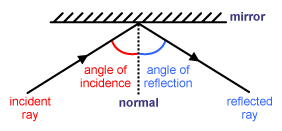
If the angle of incidence and the angle of reflection are measured using a protractor then we will always find that

ANGLE OF INCIDENCE = ANGLE OF REFLECTION

………………………………………………………………..

Curved mirrors: Images
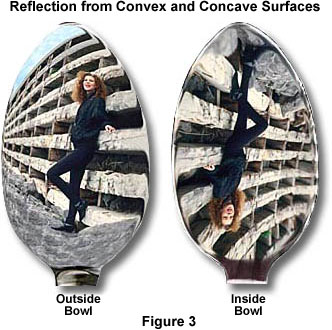
  • Images in convex mirrors are always smaller & the right way up.
  • Uses of convex mirrors: shop-lifting mirror, mirror at a road corner.
  • Images in concave mirrors can be: larger and the right way up, if eye is very close to the mirror OR smaller and upside down if eye is away from mirror.
  • Uses of concave mirrors: shaving mirror, dentist mirror.
Reaction and Enzyme

  • Cells are able to build up and break down their proteins, lipids and carbohydrates or change one to the other.
  • Eg. Animals cells build up glycogen from glucose.
  • all cells can make proteins from amino acids and they can build up fats from glycerol and fatty acids.
  • Animals cannot make proteins unless they are supplied with amino acids.
  • Plants can make their own amino acids starting from sugar and salts.

………………………………………………………………………………….

Lock and key model

http://www.scienceclarified.com/images/uesc_05_img0235.jpg

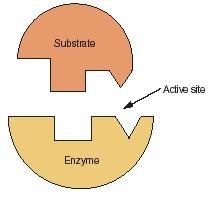
세포안에서는 수많은 물질들이 합쳐졌다가도 분해되기도 한다. 이런 chemical reactions의 속도를 맞추어주는것이 enzyme의 기능이다. Enzyme이 작용하기 위해서는 알맞는 온도와 pH가 맞아야만 하고, active site(접착기면)에 substrate(기질)이 정확이 맞아야만 한다.

Substrate가 자기만의 모양을 가지고 있듯이 화학 반응이 일어나는 표면인 active site또한 자신만의 모양을 가지고있다. 퍼즐과 퍼즐이 맞아떨어저야 그림을 이루듯, 이 두가지가 정확이 맞아떨어질때 반응이 일어나는것이다.

………………………………………………………………………………….

Enzymes are proteins that act as biological catalysts.

  • made in the cells
  • catalyst is a chemical substance that speeds up a reaction but does not get used up during the reaction.
  • anabolic enzyme reaction = join two other molecules together and form a more complicated substance. Large molecules are built up from smaller molecules.
  • Catabolic enzyme reaction = split large molecules into smaller ones.

Enzymes을 공부할땐 5가지를 꼭 기억해서 외우자.

1. Enzymes and temperature:

A rise in temperature increases the rate of most chemical reactions. A fall in temperature slows down. However, if the temperature is too high for the enzyme (eg. above 50’C) protein can be denatured and stop working. The shape of an enzyme molecule is very important if it has to fit the substances on which it acts.

2. Enzymes and pH:

Acid and alkaline conditions alter the chemical properties of enzyme. Most enzymes work best at particular level of acidity or akalinity (pH).

3. Enzymes are specific for substrates:

Enzyme that normally acts on one substance will not act on a different one.

4. Rates of enzyme reaction:

  • depends on the temperature and pH
  • concentration of the enzyme and its substrate

5. Intra- and extracellular enzymes: All enzymes are made inside cells. Most of them remain inside the cell to speed up reactions in the cytoplasm and nucleus.

Macromolecules of living cells

Cell physiology란 세포가 정상적으로 작용하기 위해 작동하는 물리적인 활동을 말한다. 소화작용, 혈액순환 뿐만 아니라 근육축소운동까지도 포함된다. 이런 다양한 물리적인 활동을 위해 우리몸은 각각 다른세포가 다른 기능을 하기위해 모양까지도 정교하게 디자인 되어있다.

The chemical components of a cell:

1. water:

  • Good solvent
  • chemical reaction
  • water pressure in vacuoles(plant) keeps the cell turgid
  • high thermal capacity – it can absorb a lot of heat without its temperature rising to levels which damage the proteins in the protoplasm. (물은 섭씨 100도나 되어야 끓을수 있는 물질이다. 그런 성질때문에 더운 날씨에도 잘 끓지않기때문에 단백질이 잘 상하지 않게된다. 하지만 0도에서 얼기때문에 영하로 내려가는 날씨에는 동상에 걸리거나, 식물들이 얼어죽게 된다.)

2. Protein: Polymers

When small organic molecules (monomers) are joined together – huge macromolecules (polymers) are formed when small organic molecules (monomers) are joined together – huge macromolecules (polymers) are formed.

  • Carbohydrates consist of monosaccharide
  • lipids consist of fatty acids
  • proteins consist of amino acids
  • nucleic acids consist of  nucleotides
  • protein has C,H,N,O,S in its molecule
  • most abundant macromolecule in the cell
  • structural, transport, hormonal functions
  • proteins very diverse in living organisms
  • 20 dif. amino acids in all living things
  • amino acids are linked together by a peptide bond
  • Enzymes accelerate chemical reactions in cells. Enzyme은 자신은 소모되지 않고 세포안의 화학작용이 빨리 진행되게 도와주는 단백질이다. 하지만 높은 온도나, 맞지 않는 pH에서는 denature가 되어버린다.
  • Denaturation = Shape of the molecules alter, and proteins loose its original properties. Proteins form enzymes and many of the structures in the cell, so if they are denatured the enzymes and the cell structures will stop working and the cell will die.

3. Carbohydrates

  • Simple, soluble sugars or complex materials like starch and cellulose.
  • all carbohydrates contain carbon, hydrogen and oxygen only
  • commonly occurring simple sugar is glucose
  • Monosaccharides = single carbon ring
  • Disaccharides = two carbon rings in their molecules
  • Polysaccharides = many glucose molecules are joined together, the carbohydrates. Not readily  soluble in water. eg) glycogen, starch, cellulose

4. Salts (ions)

  • salts are present in cells in the form of their ions eg. sodium ions, chloride ions
  • ions take part in and influence many chemical reactions in the cell.
  • involved in determining how much water enters or leaves the cell.
  • calcium, potassium, and sodium ions are particularly important in chemical changes related to electrical activities of a cell.
  • Important for responding to stimuli or conducting nerve impulses.
  • a shortage or excess of ions in the cells upsets their physiology and affects the normal functioning of the whole organism.

5. Vitamins

  • plants can make their own vitamins
  • animal cells have to be supplied with vitamins ready made.
  • play a part in chemical reactions in the cell
  • eg. transfer energy from one compound to another

I will be away – NOT ANY MORE!!

Hey, I was planning for the camp – but not anymore… so sad to miss out on this one because I always have enjoyed and made lots friends every year. T_T

However, I have life and job issues in 2010. If you are looking for an awesome summer break, let me know! Because they need you!!!

…………………………………………


From (Tues) 5/Jan/2010 to (Tues) 12/Jan/2010

I will be  leading a group for Ponui Junior Camp (Year9-10), at Ponui Island.  There will be 68 kids and a leadership team of 31.

What is Ponui Junior Camp? Here is bit about the camp.

Ponui Island in the hot afternoon sun – waterslide, kayak, sail, fish. Amped teenagers playing sport and crazy water games. Ponui at night … cook-outs, the call of kiwis. Can you see it? Can you feel it? Get there! Ponui 2010

For more info, visit – http://www.scriptureunion.org.nz/camps/ponuijunior.htm

Be aware….

Most poisonous snake bites are not fatal, and death (when it occurs) typically takes hours or days, even when the victim is left untreated.

A small amount of injected venom – combined with the size and general health of the victim – can result in moderate symptoms, including swelling, pain, and a burning sensation at the injury site; thirst and chills; and nausea. Larger amounts of hemotoxin may cause rapid heartbeat, low blood pressure, shallow breathing, convulsions, and respiratory failure.

Fatty tissue absorbs venom more slowly than muscle.

Now we know…….

Antivenin, based on the vaccine concept developed by Louise Pasteur, was invented in the late nineteenth century and is now used to treat many tpes of poisonous snakebites.

From ‘The worst-case scenario Almanac – HISTORY’ written by J.Piven, D.Borgenicht, P. Marchant & M.Wagner.

For animal lovers! – Did you know?!

(This is helpful for Year13 Biology – Animal Behaviour)

  • Domestic dogs can determine the age, gender, sexual activity, and exact identity of another dog simply by sniffing the scent marks it leaves behind.
  • Rats can smell a cat. The mere whiff of cat odour causes a rat’s blood pressure to rise dramatically, even if it has never encountered a cat before in its life.
  • Birds recognize each other by smell just as mammals do.
  • Nesting birds change the way they smell so that predators cannot sniff them out. Usually ground-nesting birds and ducks coat their feathers using a substance known as a preen wax, which repels water and inhibits the growth of feather-degrading bacteria.
  • Rats smell in stereo. With just one sniff, the rodents can workout the direction a smell is coming from. That is because the waft of an odour reaches each nostril 50milliseconds apart, a tiny but significant different that allows the rat to workout from and where the smell is emanating. When one nostril is blocked, a rat’s ability to sniff out the direction of a smell is greatly reduced.
  • Wasps and bees have such good noses that they are being used to quality-check the freshness of supermarket food. They are also being trained to sniff out the chemical ingredients of bombs or the odours produced by people with certain diseases.

From ‘Moths that drink elephants tears – And other zoological curiosities” by Matt Walker. Matt Walker is a writer and senior editor with New Scientist, the world’s leading weekly science and technology magazine.

There are lots of interesting books at libraries. Make sure you read heaps and build answers to your questions! :)