How do we see? (Part1: The Eye)

In some ways the eye is like a camera: Its optical elements focus an image of some object on a light-sensitive “film – the retina – while ensuring the correct amount of light to make the proper “exposure”.

……………………………………………………………………………………………

When your eyelids are open, light enters your eye through a circular hole called the pupil and is focussed by a lens onto the light sensitive retina attached to the back of the eye.

The size of the pupil can be adjusted to allow more light to enter when the environment is dim, and less light when it’s bright.   There are about 126 million sensory cells in the retina, both cone-shaped cells which are color-sensitive and rod-shaped cells which aren’t color-sensitive but can detect low levels of light, useful for night vision.

Most cameras work in the same way as the eye – when the shutter is open, light enters a roughly circular hole called theaperture and is focussed by a lens onto a light sensitive medium at the back of the camera, either film or an electronic sensor.   Some types of camera, like a pinhole camera, don’t have a lens, and some digital cameras don’t have a shutter; nevertheless, understanding how these things work will help make your photographs better. (ref: Flying Kiwi)


……………………………………………………………………………………………

To understand how the eye forms clear images of objects on the retina, we must examine three processes:

  1. The refraction (bending) of light by the lens and cornea
  2. The change in shape of the lens
  3. Narrowing of the pupil

More information about vision – http://www.accessexcellence.org/AE/AEC/CC/vision_background.php

……………………………………………………………………………………………

Brains learns to see

When light rays traveling through a transparent substance pass into a second transparent substance with a different density, they bend at the junction between the two. This bending is called refraction. As light rays enter the eye, they are refracted at the anterior and posterior surface of the cornea. Both surfaces of the lens of the eye further refract the light rays so they come into exact focus on the retina. Images focused on the retina are inverted; they are upside down. The reason the world does not look inverted and reversed is that the brain “learns” early in life to co-ordinate visual images with the orientations of objects. The brain stores the inverted and reversed images we acquired when we first reached for and touched objects and interprets those visual images as being correctly oriented in space.

……………………………………………………………………………………………

Physiology of Vision: Photoreceptors and photopigments
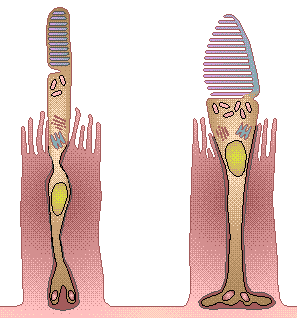
The first step in visual transduction is absorption of light by a photopigment, a colored protein that undergoes structural changes when it absorbs light. The single type of photopigment in rods is rhodopsin. Three different cone photopigments are present in the retina, one in each of three types of cones. Colour vision results from different colors of light selectively activating the different cone photopigments.  All photopigments associated with vision contain two parts: retinal and opsin. Different opsins permit the rods and cones to absorb different colours (wavelength) of incoming light. Rhodopsins absorbe blue to green light(colour) most effectively, where as the three different cone photopigments most effectively absorb blue, green, or yellow-orange light(and colour).

Science fair help: Burning peanut experiment

Measuring Energy

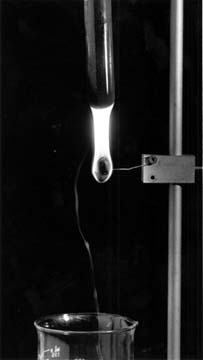
burn a peanut and boil water to meaure its calorie content

This is a particular method that measures energy in a peanut. A peanut burns producing an impressive amount of flame for a long time. The flame is used to boil away water and count the calories contained in the peanut.

Equation for calculating the calories in a peanut: To raise the temperature of 10 grams of water from 20 °C to 100 °C it takes:

Q = mcDT

Or, use the following equation to calculate the calories per gram of the peanut:

calories per gram = (heat gained by water)/(mass lost when peanut burned)

This is another way of doing the experiment.

…………………………………………………………………………………

To learn more about this experiment visit

http://www.exo.net/~pauld/activities/food/burnapeanut.html

http://www.chymist.com/energy%20of%20a%20peanut.pdf

http://www.cerlabs.com/experiments/10875406238.pdf

…………………………………………………………………………………

Bacteria

Functions of major parts

  • DNA: Contains genetic information for the bacteria. Controls all the chemical reactions within the cytoplasm.
  • Capsule: Protects bacteria from heat and chemicals
  • Flagellum: For movement.
  • Fimbriae/Pilli: For attachment (eg. on the surface of stomach)
  • Cell wall: Maintains the shape of the bacteria.
  • Ribosomes: For making protein.
  • Cytoplasm: This is where all the chemical reaction happens (including making proteins).
  • Plasma-membrane/ cell membrane: Controls what comes in and goes out.

Uses of Bacteria :

ref http://hubpages.com/hub/Uses-and-Classifications-of-Bacteria

  • A bacterium breaks down the organic fertilizer (decomposed vegetables and animal matter) into material that can be used by plants.
  • Some species of soil bacteria convert nitrogen into nitrites, compounds that are readily absorbed by plants.
  • Different commercial processes also need certain bacteria, like Anaerobic bacteria that ferment certain substances are used in the production of vinegar and some drugs, and in the aging process of cheeses.


Hepatic portal vein

Usually the capillary beds of most tissues drain into veins are lead directly back to the heart. However hepatic portal vein is an exception. In this case, blood draining the intestine is leaded to a second set of capillary beds in the liver. Then the liver removes many of the materials that were absorbed by the intestine:

  • Glucose is removed and converted into glycogen.
  • Other monosaccharides are removed and converted into glucose.
  • Excess amino acids are removed and deaminated.
    • The amino group is converted into urea.
    • The residue can then enter the pathways of cellular respiration and be oxidized for energy.
  • Many nonnutritive molecules, such as ingested drugs, are removed by the liver and, often, detoxified.

The liver serves as a gatekeeper between the intestines and the general circulation. It screens blood reaching it in the hepatic portal system so that its composition when it leaves will be close to normal for the body.

Furthermore, this homeostatic mechanism works both ways. When, for example, the concentration of glucose in the blood drops between meals, the liver releases more to the blood by

  • converting its glycogen stores to glucose (glycogenolysis)
  • converting certain amino acids into glucose (gluconeogenesis)

ref: http://users.rcn.com/jkimball.ma.ultranet/BiologyPages/G/GITract.html

Bile and Pancreatic juice

As the contents of the stomach become thoroughly liquefied, they pass into the duodenum(Small intestine). Duodenum is the first segment (about 10 inches long) of the small intestine.

Two ducts enter the duodenum:

  • one draining the gall bladder and hence the liver
  • the other draining the exocrine portion of the pancreas.

Bile

  • pH 7.6
  • bile acid: large globules of fat (liquid at body temperature) are emulsified into tiny droplets (about 1 µm in diameter) that can be more easily digested and absorbed.
  • Bile contains the products of the breakdown of hemoglobin removed by the liver from old red blood cells. The brownish/greenish color of the bile pigments imparts the characteristic brown color of the faeces.

Pancreatic juice

  • The pancreas consists of clusters if endocrine cells and exocrine cells whose secretions drain into the duodenum.
  • Contains:
  1. sodium bicarbonate (NaHCO3): This neutralizes the acidity of the fluid arriving from the stomach raising its pH to about 8.
  2. pancreatic amylase: This enzyme hydrolyzes starch into a mixture of maltose and glucose.
  3. pancreatic lipase: The enzyme hydrolyzes ingested fats into a mixture of fatty acids and monoglycerols. Its action is enhanced by the detergent effect of bile.
  4. trypsin

excretory system

The job of the excretory system is to remove various produced by the body. The removal is known as excreation. It is important for the body to remove these various waste, also known as toxic, because toxic build up can lead to servere death.

About sixty percent of your body contains water. A portion of the water is in the tissues and cells. The word excretion means the removal of waste substances from the body. Several organs are involved with the excretory system, including the kidneys, sweat glands, lungs . and rectum, The primary organs of excretions, however, are the kidney. Excretion is vital to the health of the body because the wastes are poisonous. If the wastes build up and are not eliminated, they can cause serious problems. As you know , carbon dioxide and water vapor are removed by the lungs.

Other wastes , namely urea, uric acid, various salts, and assorted nitrogenous wastes , are removed by the kidneys and sweat glands. Urea is produced when protein is broken down to glucose. The nitrogen part is the urea which is toxic to our body.

The water contains salt. the salt needs to be kept at the right concentrations. If there is little salt the body feeds it more, if there is too much salt the body gets rid of the salt not needed. This is the task of the two Kidneys.

The liver acts as a filter for the blood. It cleans out toxic waste and acid in the blood.

The skin plays a major role in excretion. It helps the body get rid of excess water, salts, and waste such as urea.

Urethra leads urine from bladder to outside, therefore it is also part of the excretory system.

what happens in the small intestine?

The small intestine is the longest portion of the digestive tract – it is more than 6 meters long and is located within the middle of the abdomen. It has three sections, the duodenum, jejunum and ileum.

Small intestine has an important function in digestion of fats, proteins and carbohydrates contained in the foods you consume. The resulting nutrients produced are absorbed through the lining of the small intestine and transferred to the bloodstream.

Blood

Blood


Oxygen is carried by red blood cells. Glucose is dissolved in the liquid part of the blood, called plasma. Plasma leaks out of the capillaries and forms tissue fluid around cells in the body. Some of the oxygen leaves the red blood cells dissolves in the tissue fluid. The red blood cells stay inside the capillary.

If you press two fingers firmly onto your wrist, you can feel your blood being pumped. This is called your pulse. Your pulse rate is the number of beats you can feel in one minute.

could you please tell me how the ecosystem works?

ECOSYSTEM IS EVERYTHING ABOUT THE HABITAT

Ecosystem is community of organisms, interacting with one another, plus the environment in which they live an with which they also interact. For example, lake, a forest, a grassland, tundra.

Such ecosystem includes all abiotic factors (non-living factors like temperature, rain fall, climate, pH, oxygen level etc) and biotic factors (living factors like predator, competitor, trophic levels, heights of trees, producers, consumers, decomposers etc.)

Knowing about a particular ecosystem is crucial to understand the animals in such habitat. So.. it is the biological term that is used to describe everything in the nature.  The term ecosystem refers to the combined physical and biological components of an environment.

Structure of the heart

Functions of the heart structures

  • ATRIUM: smaller chamber of the heart through which blood enters the heart
  • VENTRICLE: larger chamber of the heart which pushes blood away from the heart
  • AORTA: major artery carrying blood away from the left ventricle
  • VENA CAVA: main vein returning blood to the right atrium
  • CORONARY ARTERIES: the first vessels to branch from the aorta; they supply blood to the heart muscle

Here is a really really good resource for your learning.

http://inspirahealth.com/templates/animations/heartanat.swf