parasitism

Parasitism is the biology term used to describe the relation between two different kinds of organisms in which one receives benefits from the other by causing damage to it.

Eg. Mosquitoes, and Plasmodium—the parasite that causes malaria. This is an excellent example of how multiple species can be tied together in complex ecological interactions.

Continue reading “parasitism”

Double circulation of our blood circulatory system

Double Circulation of the Blood refers to the passage of the blood firstly through the lungs (the pulmonary circulation – where it picks up oxygen and releases carbon dioxide) and then through the body (the systemic circulation) where it delivers its cargo of oxygen and picks up carbon dioxide.

These two circuits are powered by different sides of the heart. The right side of the heart pushes the blood at relatively low pressure through the lungs. The left side of the heart pushes the blood at relatively high pressure through the whole body.

Cellular Respiration

Metabolism

The relationship between photosynthesis and respiration. The synthesis of ATP and ADP and inorganic phosphate, and its role as the immediate source of energy for biological processes.

  • ATP is required for endothermic processes, but can be re-synthesized when coupled to exothermic processes.
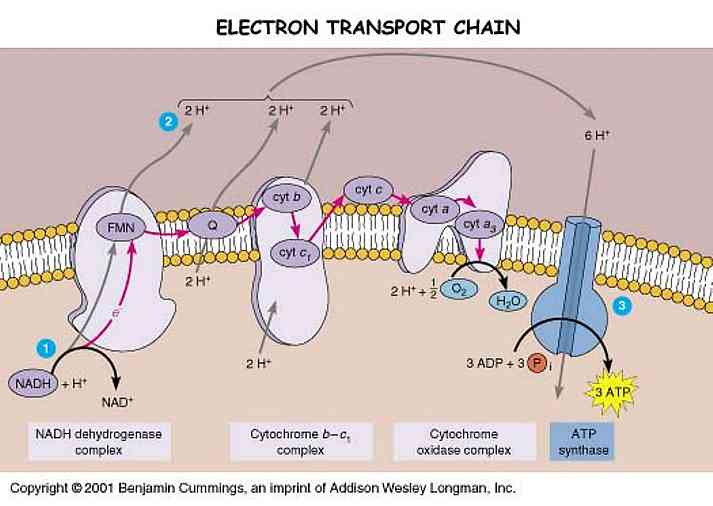
  • ATP is synthesized across the inner membranes of the mitochondria and chloroplasts, hence they are adapted to give the maximum surface area. AT[ase enzymes are powered by a proton gradient that provides the energy for ATP synthesis.
  • NADH (NADPH is used in photosynthesis) and FADH2 are reduced co-enzymes that are used to carry electrons to a different part of the organelle.

Cellular Respiration

Respiration as the process by which energy in organic molecules is made available for other processes within and organism. The structure and role of mitochondria in respiration. The biochemistry of aerobic respiration only in sufficient detail to show that:

  • Glycolysis involves the oxidation of glucose to pyruvate with a net gain of ATP and reduced NAD. Pyruvate combines with co-enzyme A to produce acetyl co enzyme A.
  • Acetyle coenzyme A combines with four-C molecule to produce six-C molecule which enters Krebs production of ATP and reduced coenzyme (NAD or FAD).
  • Synthesis of ATP is associated with the electron transport chain.

Learn the 4 stages of aerobic respiration

  1. Glycolysis (in the cytosol)
  2. The link reaction in the matrix: pyruvic acid reacts with coenzyme A to form Acetyl coenzyme A and release CO2
  3. Kreb cycle in the matrix
  4. Electron transport chain in the cristae.

Evolution or Metamorphosis?

그동안 가지고 있던 책이지만 별 관심없이 책꽂이에 꽂아만 두었던 책을 흝어보다가 의아한점을 찾아냈다. ‘신비한 생물 창조섭리’라는 책인데 거의 내용은 성경적인 시각으로 Evolution(진화)에 초점을 두어 여러가지 생물체의 활동이나 생김새를 해석한 책이다.

Natural Selection은 진화론의 한 부분인데, 진화론은 부정하면서 Natural Selection은 받아들이는 내용을 적어본다.

……………………………………………………………………

사실 어떠한 집단일지라도 이미 내재된 변이(Mutation)를 가지고 있다. 그러나 이러한 변이가 정상과 비정상을 나타내는 것도 아니고, 그렇다고 해서 다른 개체에 대한 특별한 이익을 얻는것도 아니다. 그렇지만 일단 환경이 점점 건조해지기 시작한다면 그들은 다른 식물체보다 살아난 확률이 높으며(습한 환경에서 자라지 못하는 식물의 경우), 또한 그러한 정보는 후대에도 물려줄 것이다.

즉, 다른 말로 표현하자면, 환경에 적응을 하지 못한 뿌리가 짧고 왁스물질이 적은 식물일수록 먼저 죽는다는 것이다. 이러한 과정 중의집단을 전체저그로 본다면, 평균적으로 뿌리는 심근성일 것이도 잎의 표면에는 더 많은 왁스물질(wax)을 가질것이다.

이러한 것들이 바로 새로운 적응으로 이끄는 자연선택(natural selection)인 것이다. 그러나 자연선택 그자체는 본래 있는 유전자로부터 선택하는 것이지, 한 종에서 새로운 종으로 변형시키는 데 필요한 새로운 유전적정보를 창조할 수는 없는것이다.

이 경우에 진화론자는 돌연변이가 어떤 생명체를 새로운 구조와 기능을 가진 또 다른 좀더 복잡한 유기체(eukaryote)로 진화해 나가도록 새로운 물질을 제공한다는 믿음을 가지고 있다. 그러나 이것은 잘못된 믿음으로써 전혀 실제 사실과는 부합하지 않는다. 생명체란 이미 짜여진 각본, 즉 DNA의 프로그램대로 형성되고 시기적절하게 발현되도록 되어있다.

DNA에 의해서 운반되는 유기체의 지문(code)은 이세상에 있는 어떠한 디지털 프로그램보다도 복잡하고 정교하다. 이러한 지문은 유기체가 번식할때 완벽하게 재생되는 것으로, 돌연변이란 이러한 재생시 일어나는 우연한 실수 외에는 아무것도 아닌것이다.

……………………………………………………………………

이 글은 건국대 원예학과 교수, 손기철 박사의 글이다. 난 이분의 해석에 80%로 정도밖에 동의할수 없다. Evolution은 아무도 본적이 없기때문에 가설(Thory, hypothesis)로밖에 남을 수 없다. 어느 부분에 동의하고, 하지 못하는 지는 설명하지 않겠다. 하지만..

당신의 생각은 어떤가?

General idea about Evolution

From biological view, evolution of living things could not have occurred without the ability to pass their characteristics from one generation to the next. Chromosomes has its role in transmitting an organism’s hereditary characteristics to its young by means of  ‘units of heredity’ called genes.

  • Formation of new species

New species can evolve if creatures become isolated by water, mountains, or other barriers, so can no longer breed with their own kind.

  • Natural Selection

Living things are always exposed to risk from disease, predators, and other dangers. If the young are born with differences that make them tougher, or stronger, or better suited to their surroundings, they will be able to live longer and have more babies than their weaker brothers and sisters.

This idea is called survival of the fittest, or natural selection. Nature selects the fittest and strongest for survival by killing off the weaklings. The idea was first introduced by Charles Darwin and Alfred Russel Wallace over a hundred years ago.

  • Extinction…. (멸종)

There are many reasons why some creatures gradually declined in numbers until they became extinct. Climate can change from burning deserts to freezing ice ages, so that, unless living things can migrate to better conditions, or evolve which are in some way better equipped to survive. These take over the living space and food supply of some existing species, depriving them of the necessities of life.

  • A criticism of evolution: Evolution is only a theory!?

A scientific definition of evolution is ‘a change in the genes of a population over time’. This leads, for example, to insects developing resistance of pesticides. Evolution in this sense of the word is an indisputable fact. What critics forget is that this mechanism is all that is needed to produce a variety of creatures from a common ancestor and with time, new species.

People who still insist that evolution is ‘only a theory’ imply that it is no more than a tentative suggestion. In fact this ‘theory’ is based on a mass of evidence from fossils, anatomy, ecology, genetics, animal behaviour, and more..


Protein Synthesis 2: Translation

NCEA LV2에서 배웠기때문에 Protein Synthesis가 생소하지는 않겠지만 Gene expression을 이해하려면 모든 과정을 디테일하게 알아야 헷갈리지 않는다. Animation을 보면서 3D로 이해해보자.

and bit of Mutation

  • •mRNA travels from the nucleus where it is formed to ribosomes in the cytoplasm.
  • tRNA, found in the cytoplasm, carries a particular amino acid that is related to its particular anti-codon.
  • An anti-codon is part of tRNA molecule and consists of 3 bases that pair with the complementary codon on mRNA.

Protein Synthesis 1: Transcription

The transfer of the genetic code occurs in 2stages:

1. Transcription: The code in DNA is transcribed or copied into mRNA, which travels of the cell nucleus to the ribosomes in the cytoplasm.

2. Translation: At the ribosomes, the code in mRNA is translated into a specific amino acid sequence in a protein.

……………………………………………………………………………..

Transcription

  • The genetic code in DNA is transcribed into molecule of mRNA.
  • mRNA molecule is a single strand of nucleotides joined together.
  • The order of nucleotides in an mRNA molecule is determined by the order of nucleotides in the DNA molecule from which the mRNA has been transcribed.
  • Four different kinds of nucleotides are found in RNA: (A) Adenine, (U)Uracil, (C) Cytosine, (G) Guanine
  • No thymine found in RNA strand.

……………………………………………………………………………..

Splicing

• Initially, the RNA copy of a gene includes both introns and exons.

•Introns are removed and the exons are spliced together to make a continuous strand of mRNA.

•After removal of the introns, the RNA leaves the nucleus via the pores in the nucleus envelope and passes to the cytoplasm.

Nucleic acid

  • Nucleic acid can be made up of a double helix structure or a single stranded structure.
  • DNA and RNA both are Nucleic acids
  • DNA consists of a base made up of: Cytosine, Thymine, Adenine, and Guanine.
  • RNA consists of a base made up of: Cytosine, Adenine, and Guanine. Uracil
  • Nucleic acids are built up by single nucleotides linked together.
  • Nucleotides are made up of a five carbon sugar, a nitrogen base , and a phosphoric acid.
  • Nucleotides are held together by phosphate ester bonds, which occur with the presence of oxygen and carbon atoms bonded together.

…………………………………………………………………………………….

Comparison of DNA and RNA

  • Deoxyribonucleic acid (DNA) is known to have a double helix structure, a deoxyribose sugar, and consists Thymine but not Uracil.
  • Ribonucleic acid (RNA) consists of a ribose sugar and Uracil instead of Thymine.
  • RNA is single stranded, and it translates the genetic material of DNA, into protein structures, carrying out the instructions of DNA.
  • The three subcategories of RNA are Ribosomal RNA (rRNA),messanger RNA (mRNA), and transfer RNA (RNA).

Avogadro’s constant

아보가드로의 숫자

온도와 압력이 같을 때 서로 다른 기체라도 부피가 같으면 같은 수의 분자를 포함한다는 법칙.

분자량을 그램으로 정의한 물질 1g·mol 속의 분자 개수는 6.0221367×10²³개로 이 숫자를 아보가드로 수 또는 아보가드로 상수(常數)라 한다. 예를 들어 산소의 분자량이 32.00이므로 산소 1g·mol은 32.00g이고 6.0221367×10²³개의 산소분자로 이루어진다.

1g·mol이 차지하는 부피는 0℃, 1기압인 표준상태에서 약 22.4ℓ로 아보가드로 법칙에 따라 모든 기체에서 같은 값을 갖는다.

1811년에 수년간 투린대학교 고등물리학교수를 지낸 아메데오 아보가드로가 이 법칙을 처음 제안했으나 1858년 이탈리아의 화학자 스타니슬라오 카니차로가 이 법칙을 바탕으로 화학의 논리적 체계를 세운 뒤에야 비로소 이 법칙이 일반적으로 받아들여지게 되었다.

…………………………………………

그렇다면 Avogadro는 누규?

아메데오 아보가드로(1776/ 8/ 9 ~1856/ 7/ 9)은 이탈리아의 물리학자, 화학자이다. 본명은 로렌초 로마노 아메데오 카를로 아보가드로 디 콰레그나 에 디 세레토(이탈리아어: Lorenzo Romano Amedeo Carlo Avogadro di Quarequa e di Cerreto)이다.

1776년 토리노에서 태어났다. 그의 아버지는 당시 사르데냐 왕국 피에몬테 지방에서 법률가와 의회의원으로 활동하였다. 아보가드로 역시 법률공부를 하여 1796년 법학 박사 학위를 취득하였다. 그 후 법률가로 활동하면서 1800년초 부터 수학과 물리학을 독학으로 공부하여 전기 등에 대한 논문을 발표하였다. 그 결과 1806년 토리노 대학교의 조교수가 되었고 1809년에는 왕립 베르첼리 대학의 자연 철학 교수가 되었다. 1815년에 결혼하여 6명의 자녀를 두었다. 1820년에는 토리노 대학교의 수리물리학 교수가 되었다. 또한 도량형 위원회 등 정부 기관에 관여하기도 하였다.

아보가드로는 외국어에 능통하여 그의 논문에는 프랑스어 논문이 많았으나, 살아있을 때에는 다른 화학자들과의 소극적인 접촉과 그의 연구를 그 스스로 인용하는 버릇으로 인해서 국내외에서 유명하지는 않았다.그는 1850년에 토리노 대학교 교수 자리에서 은퇴하였고, 1856년 토리노에서 사망하였다.

Reference:http://ko.wikipedia.org/wiki/아메데오_아보가드로

…………………………………………

왜 화학에서는 복잡하게 mole이나 아보가드로 숫자를 알아야할까..

화학자들을 어떤 물질을 만드느냐에 집중하기도 하지만, reactant가 얼마나 있어야 product가 얼마만큼 나오는지 알려고 한다. 이런 화학실험이 대부분 산업공장에서 이루어지기 때문이다. 몇가지 간단한 공식으로, 구입해야 하는 reactant의 양과 원하는 product의 양을 계산할수 있다.

…………………………………………

Atoms, ions and molecules are very tiny particles and it is impossible to measure out a dozen or even a hundred of them. Instead, chemists weigh out a very large number of particles. This number is the 6.0221367×10²³, ions or molecules. An amount of substance containing 6.0221367×10²³ particles is called a mole (abbreviated to mol).

So, a mole of the element aluminium is 6.0221367×10²³ atoms of aluminium and a mole of the element iron is 6.0221367×10²³ atoms if iron.