Metabolism
The relationship between photosynthesis and respiration. The synthesis of ATP and ADP and inorganic phosphate, and its role as the immediate source of energy for biological processes.
- ATP is required for endothermic processes, but can be re-synthesized when coupled to exothermic processes.
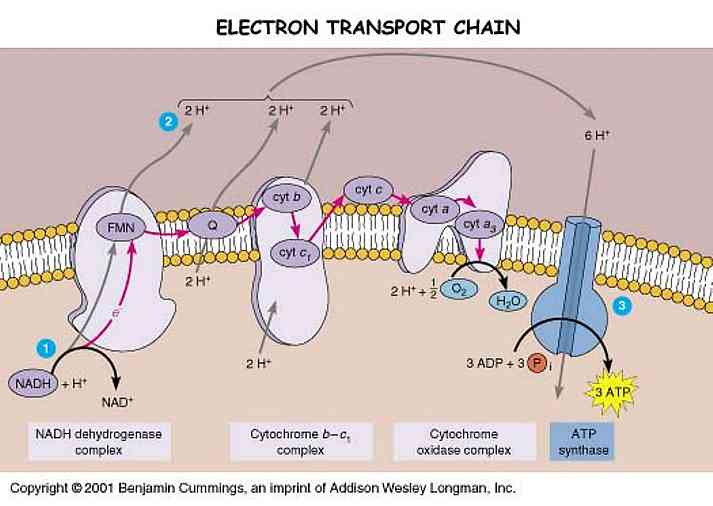
- ATP is synthesized across the inner membranes of the mitochondria and chloroplasts, hence they are adapted to give the maximum surface area. AT[ase enzymes are powered by a proton gradient that provides the energy for ATP synthesis.
- NADH (NADPH is used in photosynthesis) and FADH2 are reduced co-enzymes that are used to carry electrons to a different part of the organelle.
Cellular Respiration

Respiration as the process by which energy in organic molecules is made available for other processes within and organism. The structure and role of mitochondria in respiration. The biochemistry of aerobic respiration only in sufficient detail to show that:
- Glycolysis involves the oxidation of glucose to pyruvate with a net gain of ATP and reduced NAD. Pyruvate combines with co-enzyme A to produce acetyl co enzyme A.
- Acetyle coenzyme A combines with four-C molecule to produce six-C molecule which enters Krebs production of ATP and reduced coenzyme (NAD or FAD).
- Synthesis of ATP is associated with the electron transport chain.
Learn the 4 stages of aerobic respiration
- Glycolysis (in the cytosol)
- The link reaction in the matrix: pyruvic acid reacts with coenzyme A to form Acetyl coenzyme A and release CO2
- Kreb cycle in the matrix
- Electron transport chain in the cristae.