(Q)NCEA L3 BIOLOGY: Protein Synthesis

Here are the questions related to PROTEIN SYNTHESIS for Lv3 Biology external exam. Only some questions are answered. :)

Q1. The information carried by DNA controls protein synthesis. Protein synthesis includes transcription and translation. Discuss the reasons why both transcription and translation are necessary for protein synthesis.

ANSWER

Transcription: mRNA is synthesized using DNA (or a section of DNA/ allele) as a template. Must occur in the nucleus because DNA is confined there – in this way, DNA is protected. mRNA is needed so that the instructions carried by DNA (genetic code) can be delivered to the ribosome and expressed as a specific protein.

Translation: mRNA carries the code (sequence of bases) from DNA to the ribosome, where amino acids are joined to produce a protein and polypeptide. mRNA attaches to a ribosome in the cytoplasm, tRNA molecules bring amino acids (their order determined by the anticodon of the tRNA which matches the codon of the mRNA. Amino acids are joined on the ribosome (peptide bonds). tRNAs ensure that the genetic code is accurately translated into a sequence of amino acids in the polypeptide. Translation ensures that the instructions on mRNA are accurately interpreted, and protein beings and ends at the correct points.

DNA carries the genetic code. It is kept safe in the nucleus (protected by the nuclear envelope and histone proteins). However, to be expressed (genes used to make proteins), DNA must unwind. mRNA is made as an expendable, temporary carrier of genetic information. It is used to make the polypeptides. mRNA has a relatively short life expectancy and more mRNA can be manufactured when needed. Transcription must precede translation, but both are needed if a protein is to be produced.

Continue reading “(Q)NCEA L3 BIOLOGY: Protein Synthesis”

Evolution or Metamorphosis?

그동안 가지고 있던 책이지만 별 관심없이 책꽂이에 꽂아만 두었던 책을 흝어보다가 의아한점을 찾아냈다. ‘신비한 생물 창조섭리’라는 책인데 거의 내용은 성경적인 시각으로 Evolution(진화)에 초점을 두어 여러가지 생물체의 활동이나 생김새를 해석한 책이다.

Natural Selection은 진화론의 한 부분인데, 진화론은 부정하면서 Natural Selection은 받아들이는 내용을 적어본다.

……………………………………………………………………

사실 어떠한 집단일지라도 이미 내재된 변이(Mutation)를 가지고 있다. 그러나 이러한 변이가 정상과 비정상을 나타내는 것도 아니고, 그렇다고 해서 다른 개체에 대한 특별한 이익을 얻는것도 아니다. 그렇지만 일단 환경이 점점 건조해지기 시작한다면 그들은 다른 식물체보다 살아난 확률이 높으며(습한 환경에서 자라지 못하는 식물의 경우), 또한 그러한 정보는 후대에도 물려줄 것이다.

즉, 다른 말로 표현하자면, 환경에 적응을 하지 못한 뿌리가 짧고 왁스물질이 적은 식물일수록 먼저 죽는다는 것이다. 이러한 과정 중의집단을 전체저그로 본다면, 평균적으로 뿌리는 심근성일 것이도 잎의 표면에는 더 많은 왁스물질(wax)을 가질것이다.

이러한 것들이 바로 새로운 적응으로 이끄는 자연선택(natural selection)인 것이다. 그러나 자연선택 그자체는 본래 있는 유전자로부터 선택하는 것이지, 한 종에서 새로운 종으로 변형시키는 데 필요한 새로운 유전적정보를 창조할 수는 없는것이다.

이 경우에 진화론자는 돌연변이가 어떤 생명체를 새로운 구조와 기능을 가진 또 다른 좀더 복잡한 유기체(eukaryote)로 진화해 나가도록 새로운 물질을 제공한다는 믿음을 가지고 있다. 그러나 이것은 잘못된 믿음으로써 전혀 실제 사실과는 부합하지 않는다. 생명체란 이미 짜여진 각본, 즉 DNA의 프로그램대로 형성되고 시기적절하게 발현되도록 되어있다.

DNA에 의해서 운반되는 유기체의 지문(code)은 이세상에 있는 어떠한 디지털 프로그램보다도 복잡하고 정교하다. 이러한 지문은 유기체가 번식할때 완벽하게 재생되는 것으로, 돌연변이란 이러한 재생시 일어나는 우연한 실수 외에는 아무것도 아닌것이다.

……………………………………………………………………

이 글은 건국대 원예학과 교수, 손기철 박사의 글이다. 난 이분의 해석에 80%로 정도밖에 동의할수 없다. Evolution은 아무도 본적이 없기때문에 가설(Thory, hypothesis)로밖에 남을 수 없다. 어느 부분에 동의하고, 하지 못하는 지는 설명하지 않겠다. 하지만..

당신의 생각은 어떤가?

(답) NCEA L3: DNA Replication Q [4]

Discuss how DNA replicates. In your discussion, you should explain:

  • How replication begins.
  • The roles of the main enzymes involved.
  • Leading and lagging strands
  • Okazaki fragements
  • The source of materials for replication

(Remember, there are 5 parts to this question)

1. Replication begins when the two strands of DNA separate. This occurs by breaking the hydrogen bonds between base pairs and is carried out by the enzyme helicase.

(Scholarship: This begins at specific points along the DNA molecule called replication origins. At these points, replication initiation proteins recognize the unique base sequence and allow attachment of the helicase enzyme. Eukaryote chromosomes may have many ‘origins’.)

2. Enzymes involved include –

1) helicase: unwinds DNA strands (breaks hydrogen bonds between base pairs) and splits the two strands apart.

2) Gyrase: releases the tension in DNA strands that result from the unwinding processes.

3) RNA polymerase: synthesizes and attaches short RNA primers that allow attachment of DNA polymerase III

4) DNA polymerase III: extends RNA primers by addition of new DNA nucleotides, the exisdting strand acts as a template (complementary base is added), and on one side of the DNA molecule this creates Okazaki fragments

5) DNA polymerase I: replaces RNA primers with DNA

6) Ligase: joins Okazaki fragments, completing the lagging strand.

3. On the 3′ to 5′ DNA strand, DNA polymerase III adds nucleotides continuously : called leading strand.  On the 5′ to 3′ DNA strand, DNA is added in short lengths (Okazaki fragements); these are later joined by ligase – called lagging strand.

4. Okazaki fragments are short length of DNA (1000 to 2000 nucleotides long), formed because DNA polymerase III only synthesizes new strands in the 5′ to 3′ direction. Anti-parallel nature of DNA.

5. Materials required by this process (mostly enzymes and nucleotides) originate in the cytoplasm where they are synthesized by enzyme specific to this function. This occurs during interphase(mitosis).

6. DNA replication is semi-conservative. This means that the two original strands of the DNA molecule each become one of the strands in the daughter DNA molecules. This daughter molecules therefore consist of one parental and one newly synthesized strand.

Ref: AME NCEA L3, Biology workbook(2008)

(답) NCEA L3: DNA Replication Q [3]

Answers to Part C:

1. Describe the process of DNA replication.

DNA replication involves strands of DNA (double helical molecule with anti-parallel chains) locally unwinding to a single strand revealing free 3′ and 5’ends (via DNA helicases). DNA polymerase synthesizes new nucleotides from 5′ to 3′ end (the leading strand) and the Okazaki fragments assemble and join to the 3’end of the lagging strand. These are then linked by the enzyme ligase. The new DNA strand is rewound back into a helix.

2. DNA replication is described as a semi-conservative process. Explain what is meant by semi-conservative.

Semi-conservative replication refers to the fact that the parental DNA acts as a template for the two new strands of DNA that are synthesized. The new DNA strand consists of 50% old DNA and 50% new DNA.

(답) NCEA L3: DNA Replication Q [2]

Part B: DNA is made up of two polynucleotide chains.

Q: 1. What group of biochemical compounds are composed of nucleotides?

a: Nucleic acids.

Q: 2. What component molecules make up a nucleotide?

a: Sugar, phosphate and base

Q: 3. Where in a human cell does replication of DNA occur?

a: In the nucleus

Q: 4. Draw and show what is meant by semi-conservative replication.

Q: 5. What percentage of DNA in the second generation cell would have come from the parent cell?

a: 25%

General idea about Evolution

From biological view, evolution of living things could not have occurred without the ability to pass their characteristics from one generation to the next. Chromosomes has its role in transmitting an organism’s hereditary characteristics to its young by means of  ‘units of heredity’ called genes.

  • Formation of new species

New species can evolve if creatures become isolated by water, mountains, or other barriers, so can no longer breed with their own kind.

  • Natural Selection

Living things are always exposed to risk from disease, predators, and other dangers. If the young are born with differences that make them tougher, or stronger, or better suited to their surroundings, they will be able to live longer and have more babies than their weaker brothers and sisters.

This idea is called survival of the fittest, or natural selection. Nature selects the fittest and strongest for survival by killing off the weaklings. The idea was first introduced by Charles Darwin and Alfred Russel Wallace over a hundred years ago.

  • Extinction…. (멸종)

There are many reasons why some creatures gradually declined in numbers until they became extinct. Climate can change from burning deserts to freezing ice ages, so that, unless living things can migrate to better conditions, or evolve which are in some way better equipped to survive. These take over the living space and food supply of some existing species, depriving them of the necessities of life.

  • A criticism of evolution: Evolution is only a theory!?

A scientific definition of evolution is ‘a change in the genes of a population over time’. This leads, for example, to insects developing resistance of pesticides. Evolution in this sense of the word is an indisputable fact. What critics forget is that this mechanism is all that is needed to produce a variety of creatures from a common ancestor and with time, new species.

People who still insist that evolution is ‘only a theory’ imply that it is no more than a tentative suggestion. In fact this ‘theory’ is based on a mass of evidence from fossils, anatomy, ecology, genetics, animal behaviour, and more..


End of Protein Synthesis. Then what?

Breakdown of mRNA

  • Each mRNA molecule is read many times over before being eventually breakdown by an RNase enzyme.
  • The cell can therefore only continue to make the same protein if new mRNA molecule continue to pass out from the nucleus.
  • To decrease the rate of protein synthesis, few of the mRNA molecule coding for it are made in a given time.

Protein Synthesis 5: tRNA

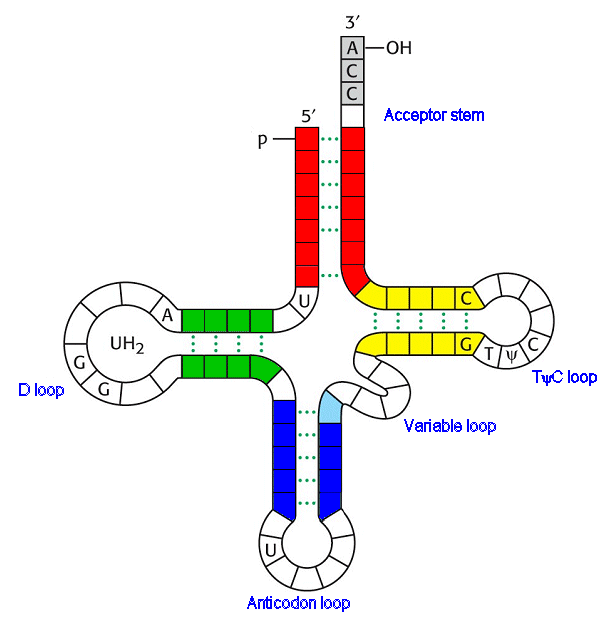
  • About 80 nucleotides in length and are made under the direction of genes in thechromosomes.
  • Different tRNA molecule for each of the different possible anti-codons because of the degeneracy of the genetic code.
  • Anti-codon at the base of each tRNA must make a perfect complementary match with the codon on the mRNA before the amino acid is released.
  • Once released, the amino acid is added to the growing polypeptide chain by enzymes.
  • Since there is different kinds of tRNA for each amino acids there must be at least 2kinds of tRNA.
  • tRNA molecule is folded back on itself giving a complex 3-D shape.
  • Each tRNA molecule must be able to combine with:
  1. One of the 20kinds of amino acid
  2. mRNA codon that specifies the amino acid

Protein Synthesis 4: Ribosome

Translation: Ribosome (rRNA)

  • Single mRNA molecule is served by many ribosomes at the same time.
  • Made up of a complex of ribosomal RNA and proteins.
  • 2 Separate sub-units until they are attracted to a binding site on the mRNA molecule.
  • Have binding sites that attract tRNA molecules loaded with amino acids.
  • Ability of a ribosome to translate the coded information in an mRNA molecule and move along it one triplet at a time.
  • It allows codon-anticodon pairing to occur.
  • It moves along the mRNA one triplet at a time.
  • Has 3 binding sites for tRNA: E-site, P-site, A-site

tRNA and Ribosome

  • tRNA in the A site is translocated to the P site, taking the mRNA along with it. Meanwhile the tRNA in the P site moves to the E site and is released from the ribosome.
  • P site is occupied by the tRNA attached to the growing polypeptide chain.
  • A site binds the incoming tRNA the next amino acid to be added.

  • Ribosome joins with the 5’end of an mRNA molecule.
  • AUG codon acts as a ‘begin here’ symbol.
  • When the ribosome reaches a ‘stop’ codon, it breaks free and can then begin reading another mRNA molecule to make another protein molecule.