Blood

Blood


Oxygen is carried by red blood cells. Glucose is dissolved in the liquid part of the blood, called plasma. Plasma leaks out of the capillaries and forms tissue fluid around cells in the body. Some of the oxygen leaves the red blood cells dissolves in the tissue fluid. The red blood cells stay inside the capillary.

If you press two fingers firmly onto your wrist, you can feel your blood being pumped. This is called your pulse. Your pulse rate is the number of beats you can feel in one minute.

How blood capillary works

Oxygen and digested food travel around the body in the blood. Blood flows through tubes called blood vessels. The smallest blood vessels are capillaries. They have thin walls with tiny gaps in so that small molecules, like water, can easily get into and out of them.

Human circulatory system

Human circulatory system


Blood from the lungs is pumped by the heart through arteries to all parts of the body. This is known as circulation. Your heart lies in your chest. It is about the size of your fist. It is divided into four chambers. Blood consist of different types of cells floating in liquid plasma. These cells included white blood cells and red blood cells. It contains iron compounds called haemoglobin, which gives red colour to red blood cells and allow red blood cells to pick up oxygen from lungs.

The right atrium receives blood from all over the body. This side of the heart pumps blood to the lungs where oxygen enters it. The left atrium receives blood from the lungs and pumps around the rest of the body. This side of the heart is bigger because it has to pump harder to get the blood all the way around the body.

About diet and nutrition

Diet

In science, the word diet means ‘what you eat’. Your food is a source of raw materials for your body. These raw materials are needed to make new substances for:

  1. Energy
  2. Growth and repair
  3. Health

Testing nutrients

We can find out which nutrients a food contains by testing it.

Starch is a type of carbohydrate. We can test for starch by adding two drops of iodine solution to a food sample. If starch is there you will see a blue/black colour.

We can test for fat by rubbing a small dry food samples on some white paper. Hold the paper up to the light. Fat will leave a greasy mark.

Balanced diet

Different foods contain different substances. There is no one food that contains all the substances that you need. You need to eat a wide variety of foods. This is called having a balanced diet. It does not matter exactly what you eat as long as you eat a balanced diet. In some parts of the world, people cannot get enough to eat and they starve. In other areas people get diseases caused by a lack of a nutrient. In New Zealand, many people are concerned about eating too much fat and sugar. Scientists and nutritionists think that eating too much fat can cause diabetes and heart diseases.

Some people go on weight control that makes them ill because the diets are not balanced or contain too little energy. People who do not eat enough often feel weak and tired. In some cases this can lead to life threatening disease called anorexia.

To stay healthy you have to keep the balanced right and eat a wide range of foods which contain all the nutrients you need.

Special diets: Diabetes

People with diabetes cannot control the amount of sugar called glucose in their blood. The amount of glucose in the blood increases after meal, but if it gets too high it can damage the kidneys and the brain. People with the disease inject a chemical called insulin which lowers the amound of glucose in the blood. Many diabetics also avoid eating too many sugary things to stop the glucose level getting too high.

People who have coeliac disease (see-li-ack) avoid eating wheat products. This is because they are allergic to a protein in wheat called gluten. The gluten causes parts of the intestine to become damaged and stops nutrients getting from their food into their bodies.

Corrosion of metals

Corrosion of metals

Metals tend to be eaten away slowly by chemical reactions. They corrode. Corrosion is a big problem in all our lives. Building materials, fasteners, tools, utensils, car bodies and many other metal things are all slowly disappearing. Metals corrode because they combine with oxygen in the air. If people made no attempt to stop corrosion we would not be able to afford to replace the metal which is disappearing back into the earth.

Iron          +      Oxygen                 –>                      Iron Oxide

Molecules and chemical reaction

Sodium        +      Chlorine                –>                      Sodium chloride

reactant + reactant –> product

Many compounds are formed from just two elements. Table salt is an example. Sodium is a soft grey metal. Chlorine is a greenish yellow gas. Both of these elements are dangerous. When sodium burns in chlorine a compound is made that is safe to eat – table salt. The chemical name for common salt is Sodium chloride.

Elements, compounds and mixtures

Elements, compounds and mixtures

Chemical substances consist of either elements in their pure form or combinations of elements. An element cannot be physically broken down into simpler substances. Different elements have different properties. Elements comprise metals and non-metals. Iron is an example of metal. Non-metals include hydrogen and oxygen. Elements combine to form compounds or mixtures. Compounds are combinations of elements joined chemically, in fixed proportion. Compounds can not be physically separated into their elements. A mixture can be separated into their elements. Mixtures are separated by processes such as filtration, sieving and evaporation. All of these involve a physical change. We can determine whether a substance is pure or not by trying to separate it physically.

Atoms and elements

Atoms and elements

All matter is made up of particles called atoms. They are too small to be seen and cannot be seen even with the most powerful microscope. There are huge numbers of atoms in the dot at the end of this sentence.

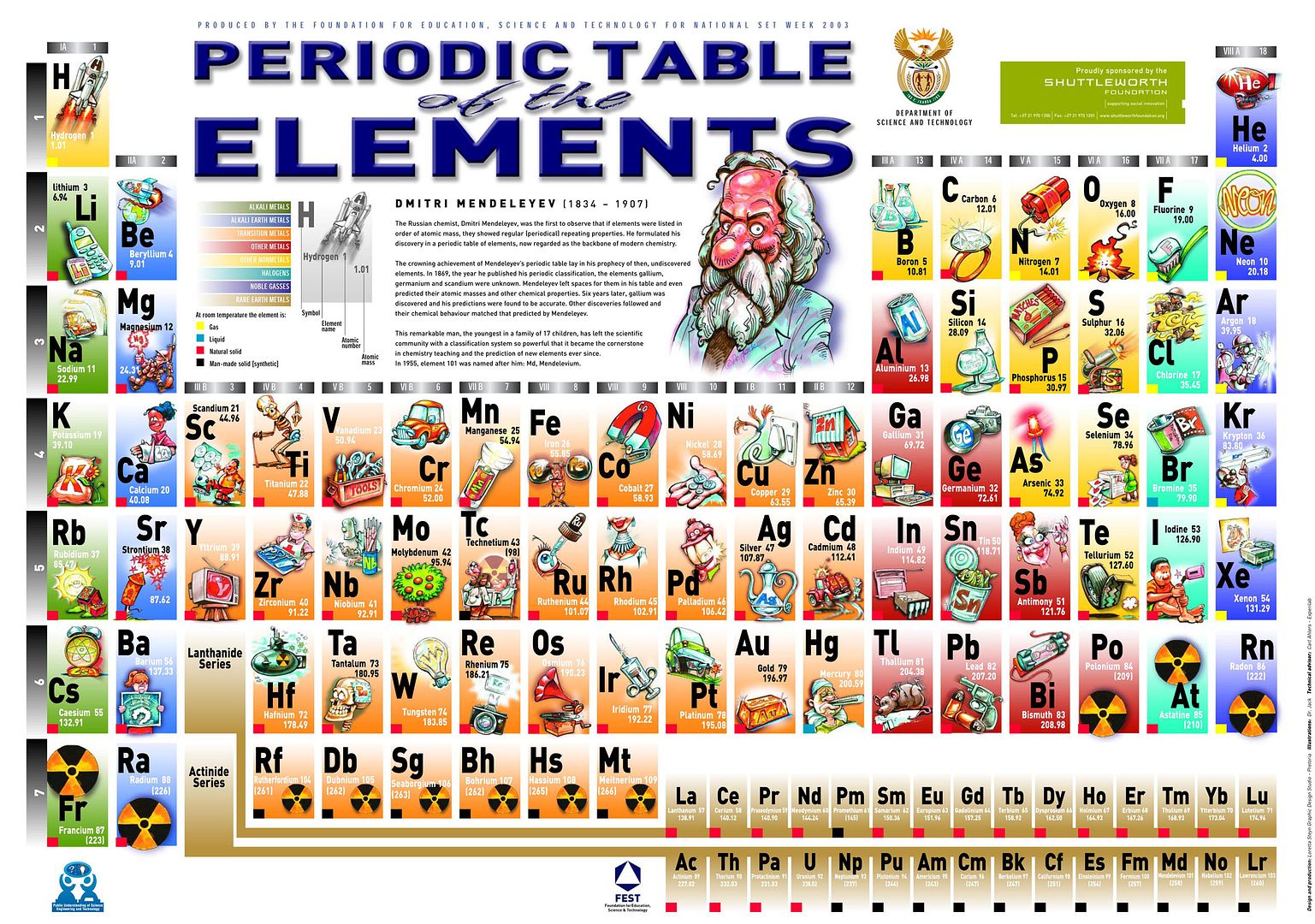
There are different types of atoms. There are about 100 different elements and each one has its own name and a particular chemical symbol by which it can be represented. Atomic symbol is either a capital letter or a capital letter and a small letter. Most atomic symbols are taken from the name of the element.

However, an element is made up of atoms which are all the same. For example, a piece of pure iron contains only iron atoms, and a test tube containing pure oxygen would only contain oxygen atoms.

http://img.photobucket.com/albums/v199/crissytrewin/PeriodicTable.jpg

Chemical changes

Chemical changes involve changes in the connections between substances. A chemical reaction can form a new substance. However, a chemical change involves the formation of a new substance, requires energy and cannot be reversed.

Chemical Change = Irreversible change = cannot be changed back

Cooking can cause an irreversible change. For example: an egg can be heated and cannot be returned to its previous state.

  • Burning materials, such as wood, paper, natural gas, causes an irreversible change.
  • Irreversible changes can form new materials that can be useful e.g. plaster of Paris and water.
  • Dead plants and animals decay and some metals rust. These chemical changes are permanent.

Summary: Filtration

  • To get water out of a solution you evaporate it.
  • The hotter it is the quicker water will evaporate.
  • To get water back from a solution, first to evaporate the water and then you condense the vapour on something cool.
  • To separate solids of different sized dry particles you sieve.
  • To separate an insoluble solid from a liquid you filter it.
  • To separate an insoluble solid from a soluble solid of similar sized particles you mix them with water and filter the insoluble solid out and then evaporate the solution to get the soluble solid back.
  • To separate a mixture of Iron filings from another solid, you can use a magnet. The magnet will attract the iron and leave the other solid behind.