Corrosion of metals

Corrosion of metals

Metals tend to be eaten away slowly by chemical reactions. They corrode. Corrosion is a big problem in all our lives. Building materials, fasteners, tools, utensils, car bodies and many other metal things are all slowly disappearing. Metals corrode because they combine with oxygen in the air. If people made no attempt to stop corrosion we would not be able to afford to replace the metal which is disappearing back into the earth.

Iron          +      Oxygen                 –>                      Iron Oxide

Molecules and chemical reaction

Sodium        +      Chlorine                –>                      Sodium chloride

reactant + reactant –> product

Many compounds are formed from just two elements. Table salt is an example. Sodium is a soft grey metal. Chlorine is a greenish yellow gas. Both of these elements are dangerous. When sodium burns in chlorine a compound is made that is safe to eat – table salt. The chemical name for common salt is Sodium chloride.

Atoms and elements

Atoms and elements

All matter is made up of particles called atoms. They are too small to be seen and cannot be seen even with the most powerful microscope. There are huge numbers of atoms in the dot at the end of this sentence.

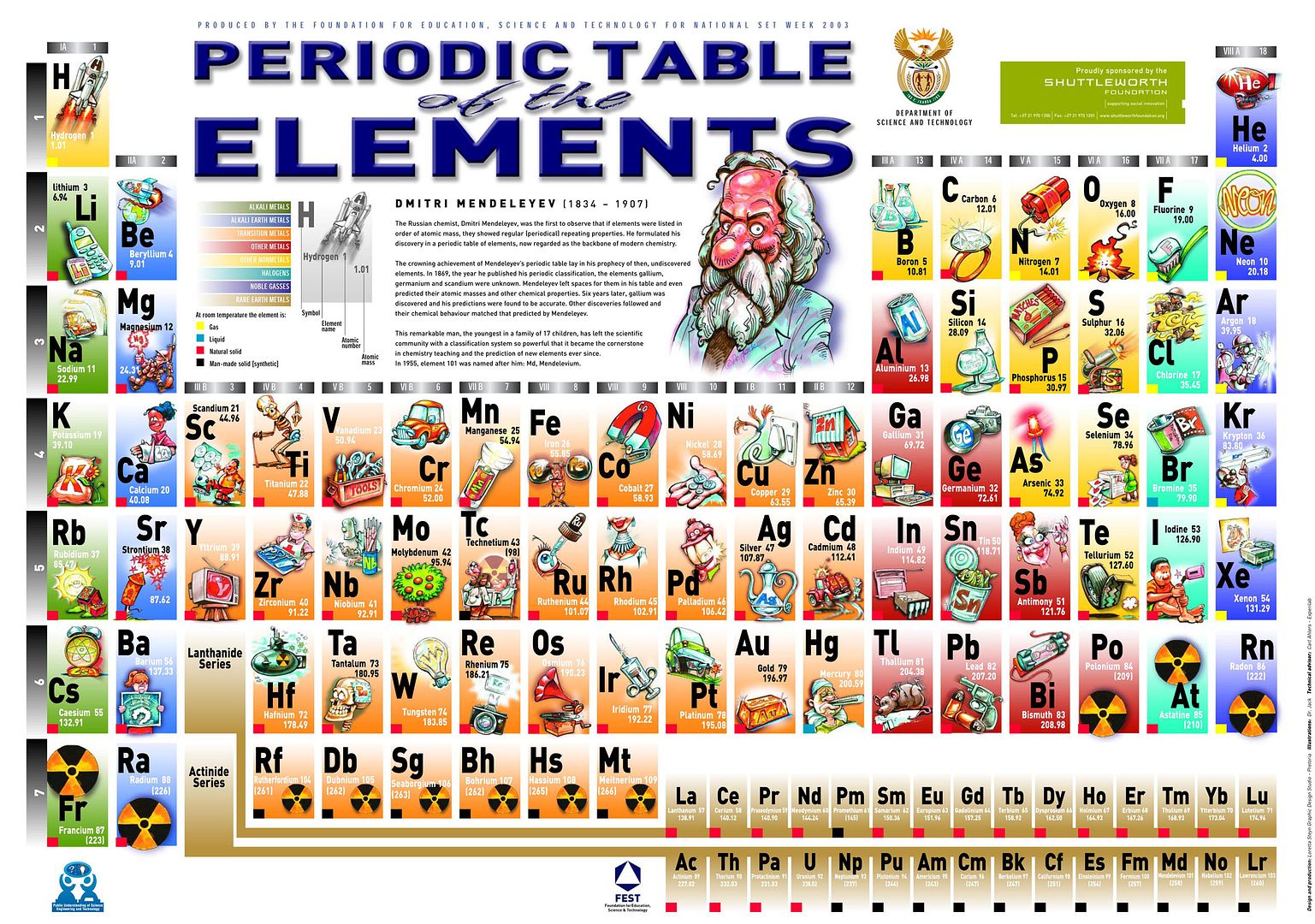
There are different types of atoms. There are about 100 different elements and each one has its own name and a particular chemical symbol by which it can be represented. Atomic symbol is either a capital letter or a capital letter and a small letter. Most atomic symbols are taken from the name of the element.

However, an element is made up of atoms which are all the same. For example, a piece of pure iron contains only iron atoms, and a test tube containing pure oxygen would only contain oxygen atoms.

http://img.photobucket.com/albums/v199/crissytrewin/PeriodicTable.jpg

Chemical changes

Chemical changes involve changes in the connections between substances. A chemical reaction can form a new substance. However, a chemical change involves the formation of a new substance, requires energy and cannot be reversed.

Chemical Change = Irreversible change = cannot be changed back

Cooking can cause an irreversible change. For example: an egg can be heated and cannot be returned to its previous state.

  • Burning materials, such as wood, paper, natural gas, causes an irreversible change.
  • Irreversible changes can form new materials that can be useful e.g. plaster of Paris and water.
  • Dead plants and animals decay and some metals rust. These chemical changes are permanent.

Summary: Filtration

  • To get water out of a solution you evaporate it.
  • The hotter it is the quicker water will evaporate.
  • To get water back from a solution, first to evaporate the water and then you condense the vapour on something cool.
  • To separate solids of different sized dry particles you sieve.
  • To separate an insoluble solid from a liquid you filter it.
  • To separate an insoluble solid from a soluble solid of similar sized particles you mix them with water and filter the insoluble solid out and then evaporate the solution to get the soluble solid back.
  • To separate a mixture of Iron filings from another solid, you can use a magnet. The magnet will attract the iron and leave the other solid behind.

Insulators and Conductors: Electrical and heat

Insulators and Conductors: Electrical and heat

  • Metals conduct electricity. (Allow electricity to pass through them)
  • Plastic is an electrical insulator. (Does not allow electricity to pass through)
  • Some metals are magnetic (See magnetism)
  • Metals are malleable, they can be molded into shape.
  • As well as electrical conductors and insulators, there are thermal conductors and insulators. When we use a saucepan we don’t want to burn our hands on them so we make the handles out of materials that won’t get hot so quickly like wood or plastic.
  • Thermal Insulators don’t allow heat to pass through them easily.  We want the food in the saucepan to get hot quickly so we make the saucepan out of metal, which is a good conductor of heat, it allows heat to pass through it easily.

  • Thermal conductors, allow heat to pass through them quickly

Metals vs. Non-Metals

Metals

Metals are classed as metals because they have certain similar properties. Other elements are classed as non-metals because they have certain other similar properties which are different from those of metals.

Metals are shiny when they are polished, where as non-metals do not shine when polished. Most metals are solid at room temperature, while non-metals can be in any of the three states of matter at room temperature. Metals are good conductors of heat and electricity, while non-metals are not. Metals can be hammered into sheets and stretched into wires, but non-metals cannot.

Some substances are classified as metal:

  • Are found underground.
  • Have many useful properties:

Strong, malleable, shiny, can be recycled, some are magnetic, some are good conductors of electricity, good conductors of heat.

  • Some have a weakness: they corrode (rust).

Non-Metal

Only 22 of the elements are non-metals. Half of these are gases, only one (bromine) is a liquid. The rest are solids. All of these elements are found on the Periodic Table.

One of the solid non-metals is sulphur. Sulphur is found naturally in areas where there are volcanoes. Sulphur melts quite easily. Like almost all non-metals it will not conduct heat or electricity.

whale meat

Scientists, film-makers team up to expose illegal international trade in whale meat

In October 2009, a man and two women walked into a renowned Los Angeles restaurant called The Hump and ordered some sushi. This seemingly innocuous act was the start of a fascinating chain of events that would involve hidden cameras, genetic sequencing, a few arrests, and the first solid proof of an illegal international trade in whale meat.

Continue reading “whale meat”

need help for science experiment project?

What should I do??


Hey.. science is a big wide field, combined of chemistry, physics and biology. If you can’t think of any project for your science experiment projects like science fair and CREST.

Think of a question first. You need to decide a field in science. If you are more interested in biology, chemistry or physics. Of course, you can combine two of these three you make the project more interesting.

Then, think of a question. This is the hardest part because you did not come across heaps of experience in science yet. I have found a really good website that gives examples of questions that you could try.

These are all found in google under a keyword ‘Science fair topics’

Cl and Cl2

Question: What does ‘Cl’ stand for and ‘Cl2′ stand for in the periodic table. Because in this level two worksheet it says that they both mean chloride but in the internet it says the ‘Cl’ is chloride and ‘Cl2′ is chlorine. Thank you~

(To read my answer – CLICK the heading or below)

Continue reading “Cl and Cl2”