Food web

This is a diagram of a food web. Almost all animals must eat other organisms to obtain energy. Animals do not generally eat just one thing, nor are they eaten by only one thing. This means that each organism, through feeding, is interconnected to many different organisms. A food web shows how all species in a community are connected.

Let’s think about the organisms in an environment. If any one species is disturbed, then all species will undergo changes in its population. Eg. If small fish numbers go down then snail and cockle numbers will go up. Big fish and seabird numbers will go down.

An animal can be both a predator and a prey. For example, a small fish may eat certain types of snails, but he may also be eaten by a duck. So the small fish is both predator and prey in this food web..

Almost all animals must eat other organisms to obtain energy. Animals do not generally eat just one thing, nor are they eaten by only one thing. This means that each organism, through feeding, is interconnected to many different organisms. A food web shows how all species in a community are connected.

We, humans, often upset the balance of different populations in natural ecosystems, or change the environment so that some species find it difficult to survive. We reduce the amount of land available for animals and plants by: building; quarrying; farming; dumping waste.

Our activities may pollute: water ‐ with sewage, fertiliser or toxic chemicals; air ‐ with smoke and gases such as sulfur dioxide; land ‐ with toxic chemicals, such as pesticides and herbicides, which may be washed from land into water.

What’s for dinner?

Ecology is the study of organisms and their relationship with their surroundings. Ecologists study the interaction between an organism and its environment. Some ecologists study a specific species or habitat. They might study the behaviour of a single species to see how it interacts with other organisms and the environment. Or, an ecologist might study many different species that either depend on each other (a food web, for example), or compete with each other for food and space

Every organism needs to obtain energy in order to live. For example,plants get , energy from the sun, some animals eat plants, and some animals eat other animals.

food chain is the sequence of who eats whom in a biological community (an ecosystem) to obtain nutrition.

  • The arrows indicate the direction of energy flow.
  • The food chain moves food from one organism to another, giving energy to the organism digesting the food.

Eg. Buttercup Bee Thrush Hawk. Plankton Herrings Salmon Seals Killer whales

  • All food chains start with the sun which provides energy for plants.
  • Photosynthesis by plants converts light energy to food. Plants are considered producers because they make their own food.
  • The producers above are grass, buttercup, rosebush and plankton.
  • Animals, including humans, cannot make their own food. As a result, they must get their energy from other sources, usually plants and other animals. Thus, animals are considered consumers.

As you can see in the diagram, food chain is the sequence of who eats whom in a biological community (an ecosystem) to obtain nutrition. Every organism needs to obtain energy in order to live. For example, plants get energy from the sun, some animals eat plants, and some animals eat other animals.

DNA란….!

Chromosome(염색체):  http://www.tiricosuave.com/images/chromosome.jpg

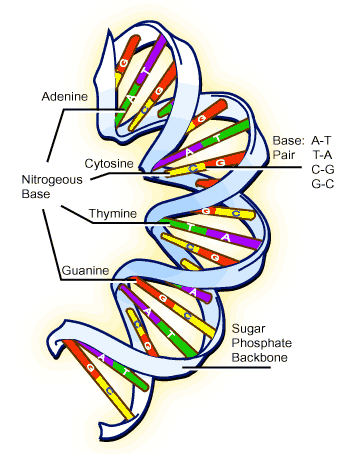
Structure of DNA: http://www.scq.ubc.ca/wp-content/dna.gif

모든 세포는 핵(nucleus)를 가지고 있는데 이 안에 들어있는것이 Chromosome이다. 앞서 설명했던 것과 같이 chromosome은 DNA로 이루어져있다. DNA는 두개의 긴 테이프가 사다리로 연경되어 나선형으로 돌고있는 형태를 취하고 있으며, 세포가 활성을 유지하기 위해 필요한 모든 정보를 지니고 있다.

만일, DNA에 구조상 결함이 있거나 DNA의 양이 충분하지 못할경우 세포의 기능은 물론 분열(Cell Division: Mitosis, Meiosis 참고)에 지장을 초래한다. 이 이유는, 세포가 분열할때 DNA는 본래의 DNA와 똑같은 두개의 DNA를 복제하는데, 이 복제가 무슨 이유에서든 일어날 수 없으면 그 세포는 두개의 세포로 나누어 질수 없거나 chromosome의 갯수(number)가 부족하게 된다.

Chromosome의 number가 달라질경우 이 세포는 죽음으로 이루게 되거나, 잘못된 세포로 임신을 하게되면 기형아기가 태어난다.

Deoxyribonucleic acid (DNA)

  • Nucleic acid (there are two nucleic acid found in living organisms, which is RNA and DNA)
  • Contains the genetic instructions used in the development and functioning of all known living organisms
  • Storage of information
  • DNA is like blueprints or a recipe, or a code,
  • It contains the instructions needed to construct other components of cells (eg. proteins)
  • DNA segments that carry this genetic information are called genes
  • Involved in regulating the use of this genetic information.

Light and Reflection

What is light???

Light is a type of energy which travels as a wave from a luminous source (eg the Sun, a flame, or a torch). Not everything is a light source. Paper reflects light from a light source towards your eyes, making you able to see it.

Light travels at a speed of 3×10⁸ m/s. Light travels faster than sound which is why you see a flash of lightning before you hear thunder! It takes 8 minutes for light from the Sun to reach Earth.

Light travels in straight lines. It can’t bend itself around objects if they are in its path. Shadows occur where light has been blocked by an object.

………………………………………………………………..

Light reflection

Lots of spectacular and beautiful effects are caused by the reflection of light. Reflections occur when light bounces off the surface of water or some other smooth surface into your eyes.

Reflection from smooth surfaces (eg mirrors or calm water) leads to regular reflection. Bumpy or rough surfaces do not reflect light evenly. The light isscattered in all directions, and usually we cannot see an image. This is known as diffuse reflection.

………………………………………………………………..

Mirror: Light reflection

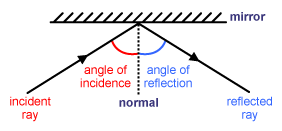
Light can be made to change direction with mirrors – this is called reflection. When light is reflected off a mirror, the angle at which it hits the mirror (angle of incidence) is the same as the angle at which it is reflected off the mirror (angle of reflection). The rays of light which hit the mirror are called the incident rays; those reflected off the mirror are called the reflected rays. The angles are always measured from the ray to the “normal”. The normal is a line at right angles to the mirror.

The laws of reflection Terms:

  • Angle of incidence: The angle between the ray of light that hits the mirror and the normal.
  • Angle of reflection: The angle between the ray of light that is reflected off the mirror and the normal.
  • Incident ray: The ray shinning onto the mirror.
  • Reflected ray: The ray that bounces off the mirror. Normal: A line that is drawn at right angle(90°) to the mirror

………………………………………………………………..

Light reflected from a plane mirror

If the angle of incidence and the angle of reflection are measured using a protractor then we will always find that

ANGLE OF INCIDENCE = ANGLE OF REFLECTION

………………………………………………………………..

Curved mirrors: Images

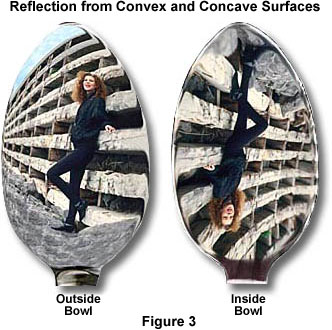
  • Images in convex mirrors are always smaller & the right way up.
  • Uses of convex mirrors: shop-lifting mirror, mirror at a road corner.
  • Images in concave mirrors can be: larger and the right way up, if eye is very close to the mirror OR smaller and upside down if eye is away from mirror.
  • Uses of concave mirrors: shaving mirror, dentist mirror.