Space probe: Galileo

Galileo Mission to Jupiter

In December 1995, the probe that had been released by the Galileo spacecraft in July 1995 entered Jupiter’ atmosphere. Galileo had traveled 2.3 billion miles since its launch in October 1989. It spent the first 3 years in the inner solar system. During one flyby in Venus and two flybys of Earth, it gathered enough velocity from the gravity of the planets to reach Jupiter. Throughout its long journey, Galileo had been sending data about solar system back to Earth.

Galileo plunged into Jupiter’s crushing atmosphere on Sept. 21, 2003. The spacecraft was deliberately destroyed to protect one of its own discoveries – a possible ocean beneath the icy crust of the moon Europa.

Galileo changed the way we look at our solar system. The spacecraft was the first to fly past an asteroid and the first to discover a moon of an asteroid. It provided the only direct observations of a comet colliding with a planet.

Galileo was the first to measure Jupiter’s atmosphere.

You can find more info from http://solarsystem.nasa.gov/galileo/?CFID=29877228&CFTOKEN=25257562

Space Probe: Voyager 1 and 2

Voyager

When Voyager I was launched in 1977 to study and photograph the giant outer planets of the Solar System, the robot ship was expected to survive just four years. However, like the battery advertising icon, the Energizer Bunny, the little spacecraft kept on going. For 25 years, the Pioneer 10 spacecraft led the way outbound, pressing the frontiers of exploration, but in 1998 the baton was passed from Pioneer 10 to Voyager 1, according to NASA’s Jet Propulsion Laboratory (JPL), Pasadena, California.

The twins, Voyager 1 and 2, opened new vistas for the human race by expanding our knowledge of Jupiter and Saturn. Voyager 2 then extended our great planetary adventure when it flew by Uranus and Neptune, becoming the only spacecraft ever to visit these worlds. (None has ever visited Pluto.)

Voyager 1, now the most distant human-made object in the Universe, and Voyager 2, close on its heels, continue their ground-breaking journey with their current mission to study the region in space where the Sun’s influence ends and the dark recesses of interstellar space begin.

Voyager 1 is almost 70 times farther from the Sun than the Earth. Out there, the Sun is only 1/5,000th as bright as here on Earth. It is extremely cold, and there is little solar energy to keep the probe warm and to provide electrical power.

(ref: http://www. secretsoftheearth.com)

Hubble telescope

Earth’s atmosphere distort the view of telescopes on the ground. This is why our stars look twinkle on the night’s sky. To see the planets and stars clearly is by placing the telescope beyond the atmosphere. Hubble telescope is 569 km above the surface of Earth and gives the clear picture of things in the space.

Every 97 minutes, Hubble completes a spin around Earth, moving at the speed of about five miles per second (8 km per second) — fast enough to travel across the United States in about 10 minutes. As it travels, Hubble’s mirror captures light and directs it into its several science instruments

(ref: http://hubblesite.org/the_telescope/hubble_essentials/)

Man in the space

People first investigated the planets using telescope. The first manmade object known to have been placed in Earth orbit was Sputnik 1 – a Soviet(Russian) satellite.

The astronauts that went to and orbited the moon would be the ones that have travelled farthest from the Earth.

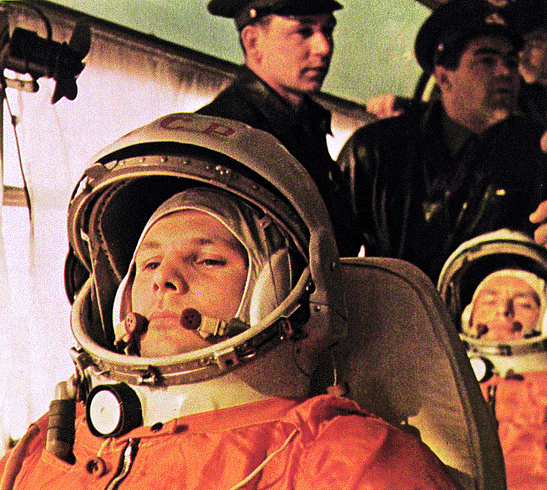
Russians have launched the first ever satellite into the orbit, then they’ve sent a dog into space (that safely returned), then Yuri Gagarin went into space. He was the first person to be in space, who blasted off on 12 April 1961 in Vostok 1. He orbited the Earth from 200 miles up.

The first man to walk on the Moon was American astronaut Neil Armstrong (1930– ). He accomplished this feat on July 20, 1969, becoming the first human from Earth to do so. Armstrong exited the lunar module, a small spacecraft connected to the main spaceship Apollo 11, and took his first steps on the Moon. He was accompanied by astronaut Edwin “Buzz” Aldrin Jr. (1930– ). As he set foot on the Moon’s surface, Armstrong spoke the historic words, “That’s one small step for a man, one giant leap for mankind.” (The live voice transmission had dropped the “a” before “man,” but it was added later.)

Any Questions?

Hey chaps!

I really love to teach and talk to you about any fields in science .  If you have a science test or need to learn something you have not come across before – bring them to the lesson. It would be a good opportunity for everyone in the group to talk about it. I am happy to give you a hand and check if you are on the right track. Any science assignment, project and homework is all welcome.

I also enjoy explaining things here if you are in hurry or can’t really come in to talk to me personally. SCIENCE is GREAT and is FUN than you would think.

Because it is the world of WONDER! and OUR WORLD is wonderful to study about.

BRING IT ON!!!

You people at Kristin school!

Bring me your science assignment or project .. or even homework to me if you want me give you a hand. You will probably do lots of experiments (on something) this term. What we are doing in the class is pretty much the theories. I feel you guys are privileged to do some hands-on activities at school.

You can ask me through blog to check if you are on the right track. By the way, I will be at A Plus academia till 2pm on Saturdays. Do not hesitate to come in because I am happy to work beside you.

Orion Program Mission to Moon and Mars

Unfortunately, this mission is cancelled yesterday due to its cost and recession. Here is the story from ABC.

US President Barack Obama has abandoned plans to return US astronauts to the moon by ending the costly Constellation next-generation rocket program.

The administration is instead directing NASA to turn to long-range research and development which could eventually lead to a manned space program to Mars.

“We are cancelling the program, not delaying it,” Mr Obama’s budget chief Peter Orszag said. (http://www.abc.net.au/news/stories/2010/02/01/2807263.htm?section=world)

PLUTO has a new name!

This is a little bit of explanation why Pluto has a new name.

Pluto is Now Just a Number: 134340

Pluto has been given a new name to reflect its new status as a dwarf planet. On Sept. 7, the former 9th planet was assigned the asteroid number 134340 by the Minor Planet Center (MPC), the official organization responsible for collecting data about asteroids and comets in our solar system.

9 Planets

  • Earth: One of the rocky planets. Its atmosphere is rich in oxygen. It has one moon.
  • Jupiter: The largest planet. It has a big red spot.
  • Mars: Smaller than the Earth. It is known as The Red planet. It has a thin atmosphere and two moons.
  • Mercury: The smallest planet. It is usually furthest from the Sun.
  • Pluto: The smallest planet. It is usually furthest from the Sun.
  • Saturn: This planet has rings around it.