could you please tell me how the ecosystem works?

ECOSYSTEM IS EVERYTHING ABOUT THE HABITAT

Ecosystem is community of organisms, interacting with one another, plus the environment in which they live an with which they also interact. For example, lake, a forest, a grassland, tundra.

Such ecosystem includes all abiotic factors (non-living factors like temperature, rain fall, climate, pH, oxygen level etc) and biotic factors (living factors like predator, competitor, trophic levels, heights of trees, producers, consumers, decomposers etc.)

Knowing about a particular ecosystem is crucial to understand the animals in such habitat. So.. it is the biological term that is used to describe everything in the nature.  The term ecosystem refers to the combined physical and biological components of an environment.

parasitism

Parasitism is the biology term used to describe the relation between two different kinds of organisms in which one receives benefits from the other by causing damage to it.

Eg. Mosquitoes, and Plasmodium—the parasite that causes malaria. This is an excellent example of how multiple species can be tied together in complex ecological interactions.

Continue reading “parasitism”

ICAS (UNSW) Science assessment test preparation

As far as I know, according to the website – http://www.eaa.unsw.edu.au/etc/icas/nz – date of the science subject is Wednesday 9 June 2010.

To download ‘science assessment framework’ click here

During the break(2 weeks) we will practice questions from past papers and similar qustions of ICAS. But this won’t happen during the normal classes. Here are the specific days which are open for you to come in.

  • Primary school students (yr4-yr6) : Tuesday 2 pm – 3pm
  • Intermediate school students (Yr7-8) : Wednesday 5:00-6:30

………………………………………………………………………..

What are we doing during these times?

If you are a primary school student, you will go through Level One(104Q) + ICAS past papers.

If you are an intermediate school student, you will go through Level One(104Q) and Two(99Q) + past ICAS papers.

………………………………………………………………………..

  • Bring clearfile (more than 30pages)
  • Ruler
  • Calculator
  • Rubber, pencil etc.

Dental Plaque

Click here to download a document about dental plaque

Plaque is the sticky, colorless film of bacteria that forms on teeth. It makes teeth “feel fuzzy” to the tongue and is most noticeable when teeth are not brushed.

Plaque develops when foods containing carbohydrates (sugars and starches) such as milk, soft drinks, raisins, cakes, or candy are frequently left on the teeth. Bacteria that live in the mouth thrive on these foods, producing acids as a result. Over a period of time, these acids destroy tooth enamel, resulting in tooth decay.Plaque can also develop on the tooth roots under the gum and cause breakdown of the bone supporting the tooth.

Plaque can be prevented by:

1. only eating sugary foods at mealtimes, not as snacks

2. brushing teeth after eating/flossing

3. using a fluoride toothpaste

4. eating a well-balanced diet

5. visiting the dentist regularly.

Microbe

A microbe is any living organism that spends its life at a size too tiny to be seen with the naked eye. Microbes include bacteria and archaebacteria, protists, some fungi and even some very tiny animals that are too small to be seen without the aid of a microscope. Viruses and the recently discovered prions are also considered microbes.

The term microbe is short for microorganism, which means small organism. To help people understand the different types of microbes, they are grouped or classified in various ways. Microbes are extremely diverse and represent all the great kingdoms of life, including the animals, plants, fungi, protists and bacteria (see the tree below). In fact, in terms of numbers, most of the diversity of life on Earth is represented by microbes.

If you want to learn more about microbe visit http://microbezoo.commtechlab.msu.edu/zoo/ziwim.html

[notes] Acid

Fizzy drinks are very popular. All these drinks have 3 things in common:

  1. They all contain a gas – Carbon dioxide gas
  2. They all contain sweeteners – either sugar of artificial sweetners
  3. They all contains acids

Acids improve the flavour of the drinks. They balance the sweetness and make them taste ‘tangy’. Fruits also contain acid called citric acid. They are called citrus fruits. The taste of lemon juice is quite sharp because of the acid. Most people prefer eating oranges to lemons, because oranges contain more natural sugar and are sweeter and less sharp. Citrus fruits also contain vitamin C, or ascorbic acid.

Vinegar is another acid that is found in many foods. As well as being put on chips, it is used in sauces, salad dressings and tomato ketchup.

How does our tasting sensory organ work?


Bits and pieces about our senses of taste

  • Taste and smell are chemical senses. They give us information about the chemical composition of our surroundings. Taste is an immediate sense – a final checkpoint for the acceptability of food before it enters the body. Smell is a more distant sense allowing us to detect small concentrations of airborne substances.
  • Taste and smell only separated when animals moved to land. Since in the sea, all chemicals are dissolved in the same medium (water) there is no need for two separate senses. Fish and other sea creatures have one general chemical sense.
  • Taste is not just in the mouth. Catfish have chemoreceptors all along their body (a catfish is like a giant tongue), and flies have receptors on their feet so that they can tell immediately upon landing whether an object is good to eat.
  • Taste is a complex mixture of flavours and aroma, or smell.
  • The receptors for the human sense of taste are located on the tongue and on the soft palate. There are just five stimuli to which these receptors respond.

……………………………………………………………………………………….

The traditional view is that tastes are detected on different parts of the tongue (see the taste map opposite). Receptors for each taste are located in taste buds in specific areas of the tongue and each area can only detect one particular taste.

However, more recent research suggests that this may not be the case. The taste buds are still found in the same areas on the tongue but each one can detect all five tastes (sweet, sour, bitter, salt and umami). The brain is able to recognise which receptors are being stimulated and this goes towards the flavour sensation that we experience. The way in which we taste foods and perceive flavours is clearly very complex.The traditional view is that tastes are detected on different parts of the tongue (see the taste map opposite). Receptors for each taste are located in taste buds in specific areas of the tongue and each area can only detect one particular taste.

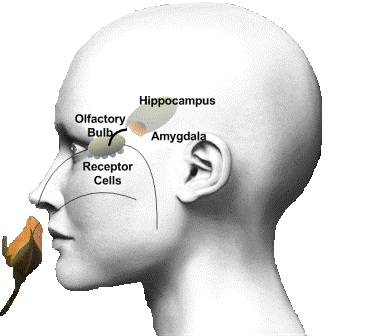
Our sense of smell also makes up a big part of how well we ‘taste’ food. Flavour molecules in the food enter the air in the nose and are detected by millions of receptors that feed information to the brain. Chewing helps to transfer more odour from the mouth to the back of the nose. The area which is sensitive to smell is located at the back of the nose where several million receptor cells per square centimetre respond to thousands of chemicals in the food.

Sight plays an unexpectedly important role in our perception of flavours. The taste of a colourless, shapeless food is extremely difficult to recognise. We may need visual “clues” to enable us to identify taste and flavour accurately.

The brain interprets signals from taste, smell and even vision before turning them into an impression of the food’s taste. Different people will find different tastes nice or unpleasant. Flavourings are added to food products to give, enhance or intensify flavour.

……………………………………………………………………..

Learning materials

냄새맡기?

킁킁킁..

코의 겉모양은 뭉툭하지만 4천여 가지나 되는 냄새를 판명할 만큼 예민하고 섬세하며 일정 수준의 자극이 닿아야 냄새를 느끼게 되는 것이 특징이다. 냄새를 맡게 되는 과정을 살펴보면 공기 중에 퍼져 있는 냄새 분자가 콧속으로 들어와서 콧속 점막의 수용체와 결합되면 자극이 후각신경을 통해 뇌에 도달되어 냄새 분자를 감지하여 구별할 수 있게 된다.
냄새를 맡는 섬모는 점막에 길게 나와 있다. 이 섬모가 직접 냄새를 맡는 것은 아니다. 이 섬모의 끝에는 지방이 뭉쳐져 있다. 공기 중에 있는 냄새는 기체로서 공기 중에 떠돌아다닌다. 공기 중에 떠돌아다니는 냄새 분자가 이 섬모에 닿아서 지방층과 접촉하게 된다. 조금 더 정확히 말하면 냄새 분자가 지방층에 녹아서 점막에 있는 신경세포가 이를 감지하게 된다. 당연히 물 속에서라면 사람들은 냄새를 맡지 못하게 된다. 이 신경세포가 감지한 정보는 뇌에서 판독되어 우리는 냄새를 지각하게 된다.

공기중에 떠 있는 냄새를 느끼기 위해서는 먼저 냄새 물질이 코에 있는 후각조직의 얇은 점막층에 닿아야 한다.이 점막은 양쪽 콧구멍 위쪽에 있다. 면적은 약 2.5㎠에 불과하지만 5백만∼1천만개의 후각세포가 이곳에 있다.

인간의 코에는 약 500만개의 후각세포가 있다. 코가 발달했다는 개는 후각세포가 2억 2,000만개로 인간의 40배가 넘는다. 이론상 인간은 10의 23승 이라는 천문학적인 종류의 냄새를 감지할 수 있다. 그러나 뇌의 후각중추에는 이런많은 종류의 냄새에 대한 정보를  저장해 둘 만한 공간이 없어 실제로 인간이 느낄 수 있는 냄새의 종류는 이보다 훨씬 적다.  인간은 원래 1만여가지의 냄새를 가릴 수 있는 능력을 가지고 있었으나,  문명발달로  인한 감각기관의 쇠퇴로 현재는 약 2,000가지 냄새를 구별할 뿐이라는 주장도 있다.

후신경세포는 냄새물질이 닿으면 뇌로 신호를 전달하는 역할을 한다. 이 후각 작용에 걸리는 시간은 대략 0.2∼0.3초 정도.점막층의 크기와 후신경세포의 수는 사람에 따라 큰 차이가 있다. 냄새 판별 능력이 사람마다 차이가 나는 것은 이 때문이다. 후각은 「선택적 피로 현상」이란 특성을 갖고 있다.쉽게 둔감해지는 것이다. 같은 냄새를 맡고 있으면 매초 2.5%씩 민감성이 감퇴돼 1분이내에 70%가 소멸한다.

집을 떠났다가 다시 돌아오면 평소에는 몰랐던 냄새를 느끼는 것도 이런 현상으로 설명된다. 후각의 피로가 풀린 탓이다.

후각은 후각으로만 작용하지 않는다. 후각신경은 대뇌 속의 변연계와도 연결돼 인간의 감정 및 생리현상과 어우러진다.

손숙영 박사는 『변연계는 우리 몸에서 호르몬 분비와 각종 생리기능, 신경전달물질 등을 관장하는 것으로 알려져 있다』며 『인간에게 유익한 향을 가려내 질병 치료에 이용하려는 연구가 활발해지고 있는 이유도 바로 이 때문이다』고 말했다.

코는 우리의 오감 가운데 가장 뛰어나고 능력 있는 감각기관이다.

그런 의미에서 눈이나 귀보다 반응이 약간은 느릴 수 있다. 냄새가 지방에 녹으려면 짧지만 약간의 시간이 필요하기 때문이다. 그리고 좋은 향기를 맡건 아주 고약한 냄새를 맡건 간에 오랫동안 냄새를 맡게 되면 냄새를 맡는 능력은 곧 마비가 된다. 나쁜 냄새를 맡을 때 사람들이 처음에는 코를 쥐지 않을 수 없다가도 잠시 후에는 일을 계속할 수 있는 것도 이 때문이다. 그래서 사람들은 코를 조금은 미련한 감각기관으로 여기는 지도 모른다. 그러나 코는 미련하지만 충성스러운 감각기관임에는 틀림없다.

그렇다면 코없는 곤충은?

어떤 동물이 냄새를 맡는다는 건 결국 공기 중에 포함된 어떤 특정한 냄새 자극을 가진 기체분자가 냄새를 느끼는 감각기에 닿는 걸 뜻한다. 사람은 그 감각기가 코 속의 점막에 있는 후세포에서 느끼지만 곤충의 경우엔 더듬이(촉각, 안테나)에서 후각을 느낀다. 빗살모양으로 가늘게 갈라진 더듬이 끝에 냄새 분자가 닿으면 그걸 느낀다다. 곤충은 페로몬이라고도 하는 의사소통의 목적으로 분비하는 화학물질로 의사소통도 가능하다. 이것이 바로 냄새를 내 더듬이끼리 서로 비비면서 받아들이는 것이다. 한 나방은 5km 밖의 암컷이 분비하는 페로몬도 감지한다고 한다.

If you wish to find this out in English… CLICK HERE

rE: Elizabeth’s Question

I really need help on the Exploring space thing, I’ve done everything else it’s just the exploring space thing that I need help with, I looked on the blog and it said something about Galelio( not sure how you spell it) So does that mean Galelio was the first investigation thing(probe)? On google it says stuff like the telescope on Wiki Answers. Which one’s right? Is any of them right??

—————————————————————————————-

Here is my answer for the question. Elizabeth, Galileo is the name of a probe which was launched in 1995 to observe the space. The difference between space probe like Galileo and telescope is that space probe stays in space but telescope is placed in Earth. As the other article says, the space probe provides us with vivid picture since the space is vacuum. My question in the book is asking you “where they went and what they found out”.

Galileo travels around space and it has also entered Jupiter’ atmosphere.

So it went to Jupiter and Venus. Throughout its long journey, Galileo has sent  data(information) about solar system back to Earth.

But  Galileo plunged into Jupiter’s crushing atmosphere on Sept. 21, 2003. The spacecraft was deliberately destroyed to protect one of its own discoveries – a possible ocean beneath the icy crust of the moon Europa.

Galileo changed the way we look at our solar system. The spacecraft was the first to fly past an asteroid and the first to discover a moon of an asteroid. It provided the only direct observations of a comet colliding with a planet. Galileo was the first to measure Jupiter’s atmosphere.

Don’t really know if it was the first space probe ever.

What is an Acid?

The word ‘acid’ is derived from a Latin word, which means “sour”. The sour taste of most of the fruits and vegetables is due to various types of acids present in them. The digestive fluids of most of the animals and humans also contain acids.

An acid is a compound and it dissolves in water.

Every liquid you see will probably have either acidic or basic traits. One exception might be distilled water. Distilled water is just water – it is therefore neutral.

We read a newspaper story about someone being terribly burned by an acid. In fact, most of us think of acids as dangerous liquids which can burn the skin and eat holes in clothing. This is only true of a very small number of acids. There are many acids in foods, and they are necessary for good health. Other acids are used to make drugs, paints, cosmetics, and industrial products. There are many kinds of acids but they all may be divided into two classes, inorganic acids and organic acids.

Examples of acids:

  • Hydrochloric acid is an other very strong acid. It can be made from sulphuric acid and common table salt. It is used to make other chemicals and is very good for cleaning metals. The human body makes a small amount of weak hydrochloric acid, which helps in digestion.
  • Nitric acid is another powerful acid which can harm the skin and eyes.
  • Boric acid, on the other hand, is a very weak acid. It occurs naturally in Italy. It is used to make ceramics, cements, pigments, and cosmetics. It is sometimes used as a germ-killer, but is not very good for this purpose.
  • Carbonic acid comes from carbon dioxide gas, and there is some of it in the soda pop we drink.
  • Arsenic acid is used to make insect-killing products. Organic acids are not as strong as inorganic acids.
  • Acetic acid is found in vinegar, and can be made by fermenting apple cider.
  • When sugar ferments in milk, lactic acid is formed. It turns the milk sour, but it is also used in making cheese. Amino acids are needed to keep the body in good health, and they come from protein foods.
  • Oranges, lemons, and grapefruit contain ascorbic acid, which is the chemical name for Vitamin C.
  • Liver, poultry, and beef contain nicotinic acid, which helps prevent skin diseases.

So you see that the story of acids is a long and complicated one. Some are dangerous to human beings, but useful in industry. Some are necessary for human life and are supplied by various foods. Some are made by the body itself to keep it functioning.