Hubble telescope

Earth’s atmosphere distort the view of telescopes on the ground. This is why our stars look twinkle on the night’s sky. To see the planets and stars clearly is by placing the telescope beyond the atmosphere. Hubble telescope is 569 km above the surface of Earth and gives the clear picture of things in the space.

Every 97 minutes, Hubble completes a spin around Earth, moving at the speed of about five miles per second (8 km per second) — fast enough to travel across the United States in about 10 minutes. As it travels, Hubble’s mirror captures light and directs it into its several science instruments

(ref: http://hubblesite.org/the_telescope/hubble_essentials/)

Nucleic acid

  • Nucleic acid can be made up of a double helix structure or a single stranded structure.
  • DNA and RNA both are Nucleic acids
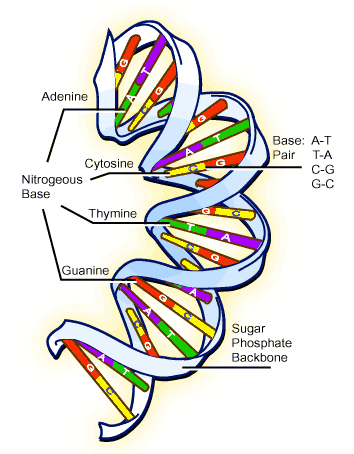
  • DNA consists of a base made up of: Cytosine, Thymine, Adenine, and Guanine.
  • RNA consists of a base made up of: Cytosine, Adenine, and Guanine. Uracil
  • Nucleic acids are built up by single nucleotides linked together.
  • Nucleotides are made up of a five carbon sugar, a nitrogen base , and a phosphoric acid.
  • Nucleotides are held together by phosphate ester bonds, which occur with the presence of oxygen and carbon atoms bonded together.

…………………………………………………………………………………….

Comparison of DNA and RNA

  • Deoxyribonucleic acid (DNA) is known to have a double helix structure, a deoxyribose sugar, and consists Thymine but not Uracil.
  • Ribonucleic acid (RNA) consists of a ribose sugar and Uracil instead of Thymine.
  • RNA is single stranded, and it translates the genetic material of DNA, into protein structures, carrying out the instructions of DNA.
  • The three subcategories of RNA are Ribosomal RNA (rRNA),messanger RNA (mRNA), and transfer RNA (RNA).

Cell Division

Mitosis : Cell division in body cells (somatic cells)

When a cell is not dividing there is not much detailed structure to be seen in the nucleus. Just before cell division, a number of long, thread-like structures appear in the nucleus. These threads are called chromosomes.

Each chromosome is seen to be made up of two parallel strands, called chromatids. When the nucleus divides into two one chromatid from each chromosome goes into each daughter nucleus. The chromatids in each nucleus now become chromosomes and later they will make copies of themselves ready for the next cell division. The process of copying is called replication. It is called replication because it makes the exact copy of itself.

Mitosis has specific function in producing new cells for growth or replacement.

…………………………………………………

Meiosis: Cell division in sex cells(sperm/egg) of reproductive organs.

In a cell which is going to divide and produce gametes, the diploid number of chromosomes shorten and thicken as in mitosis. The pairs of homologous chromosomes, lie alongside each other and when the nucleus divides for the first time. It is the chromosomes and not the chromatids which are separated. This results in only half the total number of chromosomes going to each daughter cell.

DNA란….!

Chromosome(염색체):  http://www.tiricosuave.com/images/chromosome.jpg

Structure of DNA: http://www.scq.ubc.ca/wp-content/dna.gif

모든 세포는 핵(nucleus)를 가지고 있는데 이 안에 들어있는것이 Chromosome이다. 앞서 설명했던 것과 같이 chromosome은 DNA로 이루어져있다. DNA는 두개의 긴 테이프가 사다리로 연경되어 나선형으로 돌고있는 형태를 취하고 있으며, 세포가 활성을 유지하기 위해 필요한 모든 정보를 지니고 있다.

만일, DNA에 구조상 결함이 있거나 DNA의 양이 충분하지 못할경우 세포의 기능은 물론 분열(Cell Division: Mitosis, Meiosis 참고)에 지장을 초래한다. 이 이유는, 세포가 분열할때 DNA는 본래의 DNA와 똑같은 두개의 DNA를 복제하는데, 이 복제가 무슨 이유에서든 일어날 수 없으면 그 세포는 두개의 세포로 나누어 질수 없거나 chromosome의 갯수(number)가 부족하게 된다.

Chromosome의 number가 달라질경우 이 세포는 죽음으로 이루게 되거나, 잘못된 세포로 임신을 하게되면 기형아기가 태어난다.

Deoxyribonucleic acid (DNA)

  • Nucleic acid (there are two nucleic acid found in living organisms, which is RNA and DNA)
  • Contains the genetic instructions used in the development and functioning of all known living organisms
  • Storage of information
  • DNA is like blueprints or a recipe, or a code,
  • It contains the instructions needed to construct other components of cells (eg. proteins)
  • DNA segments that carry this genetic information are called genes
  • Involved in regulating the use of this genetic information.